Padel Lighting Mistakes: 4 Design Errors Players Notice Immediately
- VKS
- Jul 08, 2026
- Blog
Padel lighting mistakes are rarely visible on a spec sheet. A court can pass its lighting audit with lux numbers that look right on paper, and players will still come back with the same complaint: it just doesn't feel right.
The problem is rarely the lux level itself. It usually comes down to lighting design as a whole. Players never remember whether a court measured 500 lux or 750 lux. What they remember is a feeling: was the ball easy to track, did their eyes get tired, did the whole match feel smooth.
Why Padel Lighting Mistakes Happen Even When Lux Meets the Standard
Lux is only one measure of lighting quality. What actually shapes match experience is a combination of factors: uniformity, glare control, vertical illuminance, and fixture layout working together.
What players perceive on court is Visual Continuity. Can they lock onto a high ball the moment it leaves the racket. Does their line of sight stay comfortable when they turn to chase a return. Does a sudden shift between bright and dark areas throw off their judgment.
When that continuity breaks, the eyes have to keep readjusting between bright and dark zones. This constant readjustment is called Eye Adaptation, and it is the main driver of visual fatigue during a match.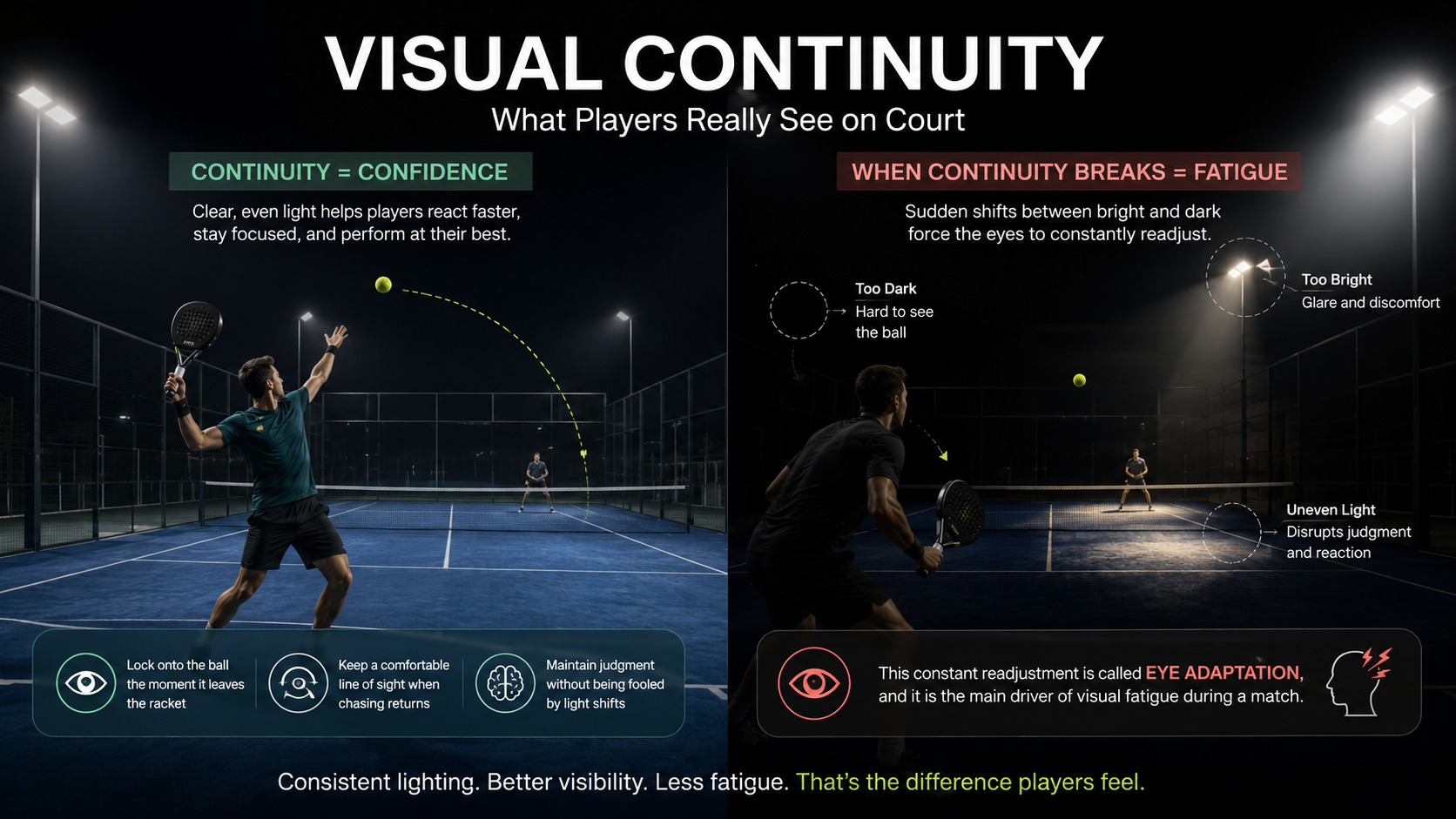
Padel Lighting Mistake #1: Measuring Only Ground-Level Lux
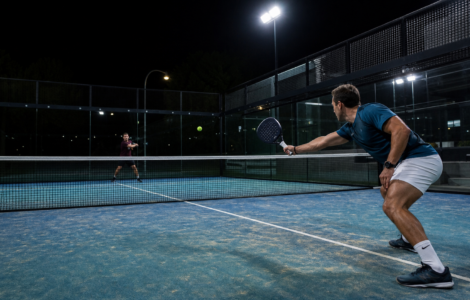
Padel differs from sports like football or basketball in one key way: the ball spends most of its time off the ground. Lob shots, smashes, and glass rebounds all require players to track the ball continuously in the air.
This is why vertical illuminance matters as much as horizontal lux. Without enough vertical illuminance, the ball can appear to flicker between visible and invisible, even when ground-level lux is high. The effect is most noticeable during lobs and fast rallies.
Key Lighting Metrics
- Average illuminance — controls overall brightness
- Uniformity — reduces bright-to-dark variation
- Vertical illuminance — improves ball visibility in the air
- Glare rating (GR) — determines visual comfort
Padel Lighting Mistake #2: Poor Uniformity
A court can hit its target lux and still fall short on uniformity. This gap is easy to miss during handover inspection, but it shows up after players have been on court for an hour.
Every time a player moves between a brighter zone and a darker one, their eyes trigger Eye Adaptation again. Repeated over a full match, this steady readjustment lowers visual comfort and slows reaction time.
Project Reference: 4 Outdoor Padel Courts, May 2026
| Installation height | 6 m |
| Fixture setup | 4 x 400W Linear High Bay per court |
| Average illuminance | >500 lux |
| Uniformity | 0.80 |
| Max GR | 27 |
The project met commercial operating standards while players reported consistent visual comfort throughout play, with no noticeable glare interference.
Padel Lighting Mistake #3: One Fixture Doesn't Guarantee Good Lighting
Most buyers start by comparing fixture specs. But the same fixture can perform very differently from one court to another. What actually determines the outcome is how several variables work together:
- Mounting height
- Pole position
- Beam angle
- Fixture orientation
- Court dimensions
Good lighting design is a balance across these variables, not simply a matter of adding more wattage. This is also why pre-installation lighting simulation has become standard practice on more projects. It confirms illuminance and uniformity before construction begins, while giving engineers room to fine-tune fixture placement and avoid costly rework later.
Related reading: LED Linear Lighting vs Traditional Floodlights for Padel Courts
Padel Lighting Mistake #4: Focusing on GR Alone
GR is a useful glare metric, but it doesn't tell the whole story. Two courts with nearly identical GR values can still deliver very different player experiences. The reason is that a player's Sightline is never fixed. Over the course of a match, players are constantly looking up to track a lob, turning to chase a ball, or facing the glass to play a return.
If a fixture sits directly in one of these sightlines, it can still cause discomfort even when GR is technically within spec. Strong anti-glare performance comes from anticipating real player sightlines across the whole layout, not from optimizing a single fixture's spec sheet.
Related reading: Why Glare Matters More Than Brightness in Modern Padel Clubs
Conclusion: Fixing Padel Lighting Mistakes Starts with Design, Not Wattage
Padel lighting is shifting from meeting a standard to optimizing an experience. Lux still matters, but it's the starting point of a good design, not the finish line.
What actually shapes player experience is uniformity, vertical illuminance, glare control, and fixture layout working together. The goal of professional lighting design isn't to make a court look brighter. It's to make players forget the lighting system exists at all, throughout an entire match.
FAQs
Q1: What is the minimum lux level required for a padel court?
Most competitive padel courts target an average illuminance above 500 lux, with tournament or broadcast-grade venues often requiring higher levels.
Q2: Why does vertical illuminance matter more in padel than in other sports?
Because padel involves frequent lob shots, smashes, and glass rebounds, the ball spends significant time in the air. Vertical illuminance ensures players can track the ball clearly at different heights, not just on the court surface.
Q3: What uniformity ratio should a padel court aim for?
A uniformity ratio (U0) of 0.7 or higher is generally recommended for padel courts. Values around 0.80, as seen in well-designed installations, help minimize eye fatigue during extended play.
Q4: What GR value is considered acceptable for padel lighting?
A glare rating (GR) below 30 is typically considered comfortable for players. Lower values indicate less visual discomfort, especially during fast rallies and overhead shots.
Q5: Do I need a lighting simulation before installing padel court fixtures?
Yes, especially for multi-court or commercial projects. Simulation software like DIALux allows designers to verify illuminance, uniformity, and glare performance before installation, reducing the risk of costly rework.
Q6: Can one lighting fixture work for every padel court?
Not necessarily. The same fixture can perform differently depending on mounting height, pole position, beam angle, and court dimensions. Lighting performance is a system-level outcome, not a single-product spec.