Why Glare Matters More Than Brightness in Modern Padel Clubs
- VKS
- Jun 23, 2026
- Blog
Why Padel Players Are More Sensitive to Glare
Not all sports reate equal exposure to glare. Padel is uniquely demanding on the visual system for three structural reasons.

Glass Walls Increase Light Reflection
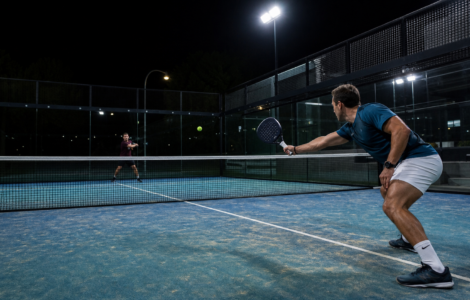
Unlike concrete or mesh enclosures, the glass panels surrounding a padel court act as secondary light sources. Fixtures mounted overhead or to the side can produce reflections that shift during play, creating intermittent visual interference. In evening or indoor settings — where operators most frequently host padel matches — these reflections create significantly more pronounced glare. A player who has just adapted to the ambient light level suddenly encounters a specular bounce from the rear wall, and this bounce immediately disrupts their vision.
Frequent High Ball Tracking Creates Visual Pressure
Padel's tactical game revolves around the lob. Tracking a lob ball requires players to look nearly vertically upward — directly into the field of view where luminaires sit. A player staring up at an overlit fixture mid-rally isn't just uncomfortable; they lose the ball. This happens multiple times per match, and the accumulated visual pressure over an hour of play translates into fatigue that members associate with the venue, even if they can't name the cause.
Smaller Court Spaces Make Direct Glare More Noticeable

A padel court measures 20m × 10m — far smaller than a football pitch or a full-size tennis court. With less distance between luminaire and player, the solid angle subtended by the light source is larger, and the probability of direct glare intrusion is correspondingly higher. In enclosed padel environments, there is significantly less room for error in fixture placement and aiming than most buyers appreciate.
Brightness Alone Does Not Define Lighting Quality
The instinct to specify lighting by lux level is understandable — it's measurable, standardised, and easy to compare. But it tells only part of the story.
High Lux Does Not Always Improve Player Comfort
A court lit to 500 lux with poor uniformity and no glare management can feel worse to play on than a court at 350 lux with well-controlled optics and a balanced distribution. Clients who experience this disconnect often can't articulate why they dislike the lighting — they just know something feels wrong. Brightness creates the expectation of quality; glare and inconsistency destroy it.
Uniformity Plays a Major Role in Visibility
Uniformity ratios (Uo and U1) determine whether illuminance is consistent across the court surface. Sharp transitions between bright zones directly under fixtures and dimmer zones in between force the visual system to continuously readapt. Over the course of a one-hour session, this cycle of adaptation and recovery accelerates eye fatigue in ways that players notice as tiredness rather than identifying the specific cause.
Vertical Illuminance Is Often Overlooked
Standards increasingly reference vertical illuminance (Ev) alongside horizontal illuminance (Eh), yet many low-cost proposals still specify based on horizontal measurements alone. In padel, where ball trajectories regularly exceed head height and the lob is a primary strategic shot, vertical illuminance in the upper play zone matters as much as floor-level lux. Proposals that ignore Ev are not fully specifying the space.
Why Low Glare Lighting Is Becoming More Important in Premium Padel Clubs
The padel market has segmented. At one end are entry-level facilities — converted warehouses, standalone outdoor installations — where cost-per-court dominates the specification conversation. At the other end are urban premium clubs that compete on experience, brand, and member retention.
Premium Clubs Focus More on Player Experience
For high-end membership clubs, glare control is not a technical detail — it is a product attribute. Members who play three times a week notice the difference between a facility where they leave with tired eyes and one where they feel sharp after an hour of play. That perception has direct commercial implications: retention, referrals, and the willingness to renew at premium price points. Lighting quality at this segment level functions as part of the service proposition, not just the infrastructure.
Indoor Padel Projects Have Higher Visual Comfort Requirements
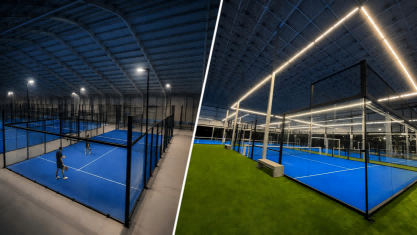
Indoor padel projects amplify the design challenge considerably. Lower ceiling heights constrain mounting positions, limit the ability to push fixtures back from the court boundary, and create ceiling bounce effects where diffused light washes back down unevenly. These conditions require more precise optical design — not just higher lumens. Some indoor premium club projects are now explicitly targeting GR values below 30, a threshold that demands dedicated anti-glare optics and careful aiming angle calculation, not off-the-shelf fixture placement.

- EN12193 lighting standard for indoor and outdoor padel courts
Social Media and Venue Aesthetics Now Matter More
The social dimension of padel is also relevant from a specification standpoint. Padel is inherently photogenic, and clubs rely on user-generated content for organic marketing reach. A court that photographs well — with balanced, shadow-free light and no visible glare halos — works as a passive marketing asset across every session. The lighting specification influences the Instagram feed, which influences membership enquiries. This is not a trivial consideration for clubs investing in brand positioning.
The Relationship Between Uniformity and Glare
Uniformity and glare are related but distinct problems, and solving one without addressing the other produces incomplete results.
Reducing Brightness Alone Is Not the Solution
The instinctive response to a glare complaint is to reduce output — lower the wattage, dim the fixtures. This trades one problem for another. Reducing brightness below the recommended illuminance threshold for the sport's level of play degrades visibility for players and creates a substandard playing environment. The goal is not less light but better-controlled light: the same or greater lux output, delivered without intrusive direct or reflected glare vectors.
Poor Uniformity Can Increase Eye Fatigue
Even where peak glare is controlled, non-uniform distributions create their own visual fatigue problem. A court with good average lux but a uniformity ratio of Uo < 0.5 generates frequent high-contrast transitions across the playing surface. The visual system adapts to each zone as the player moves, and the cumulative load across a match session is significant. Poor uniformity and poor glare control together produce a court that players describe simply as "tiring to play on."

Balanced Lighting Design Improves Match Experience
The correct objective is a balanced system: adequate illuminance on both horizontal and vertical planes, a uniformity ratio that meets or exceeds relevant sports standards, and a GR value that keeps direct and reflected glare within comfortable thresholds. Achieving all three simultaneously requires design iteration — it cannot be guaranteed by fixture selection alone. This is why professional simulation is not an optional step but a fundamental part of responsible project delivery.
Fixture Selection Is Only Part of the Solution
This is where many procurement conversations stall. Buyers compare fixture specifications — efficacy, IP rating, CCT, CRI — without recognising that glare performance is not a property of the fixture alone.
Beam Angle and Fixture Positioning Affect Glare Directly
The same fixture can produce very different GR outcomes depending on mounting height, aiming angle, and the optical lens configuration selected. A narrow beam angle reduces spill and controls glare in one direction while potentially introducing hotspots if inter-fixture spacing is too wide. A wide beam improves uniformity but increases the likelihood of direct glare intrusion if the fixture is positioned too low or aimed incorrectly. There is no universal answer; every project geometry requires its own optimisation.
Pole Layout Can Change Player Visibility
A four-pole arrangement positions fixtures at the corners of the court; a six-pole layout adds mid-side mounting points and changes the viewing angle relationship between player and luminaire entirely. Neither is inherently superior, but each produces a different light distribution pattern and a different GR exposure profile for players at various court positions. Selecting a pole layout without modelling its glare implications is a significant design omission.
Optical Lens Design Matters More Than Many Buyers Expect
The optical lens configuration — asymmetric distributions, anti-glare baffles, honeycomb louvres — has a larger impact on glare performance than raw wattage. A lower-wattage fixture with precision optics designed for sports applications will routinely outperform a higher-wattage standard industrial floodlight on GR metrics. Buyers who evaluate proposals purely on watts per dollar are systematically undervaluing the variable that most affects player experience.
Different Lighting Layouts Create Different Visual Experiences
Comparing Linear Lighting and Traditional Floodlight Approaches
Traditional multi-fixture floodlight arrangements and linear perimeter lighting systems each have legitimate applications in padel court design. Linear systems mounted at low perimeter height typically produce lower GR values because the elongated luminous surface distributes light rather than concentrating it, and the viewing geometry keeps bright sources outside the critical upward field of view. Floodlight arrangements generally require fewer mounting points, and they fit outdoor multi-court complexes better where courts share pole infrastructure. Professional design allows both approaches to achieve excellent uniformity and GR compliance — venue geometry, ceiling height, and project budget should drive the selection, not assumption. (For a detailed comparison, see:LED Linear Lighting vs Traditional Floodlights for Padel Courts.)
Real Project Case Study: Two Schemes, One Court, Very Different Visual Outcomes
For one indoor padel project, we developed two alternative schemes against the same 800 lux target illuminance, giving the client a side-by-side comparison before committing to any hardware. Scheme A used a traditional floodlight approach with orange-peel optics; Scheme B used a linear grid luminaire system. Both were fully validated in DIALux prior to submission.
| Scheme A — Floodlight | Scheme B — Linear Grid | |
|---|---|---|
| Fixture Model | VKS-FL0300D90-X20 | VKS-LL30X70-1.4MX60W |
| Single Fixture Flux | 42,544 lm | 8,267 lm |
| Wattage per Fixture | 295.6 W | 58.4 W |
| Quantity | 12 pcs | 34 pcs |
| Total Wattage | 3,547.5 W | 1,985.6 W |
| Installation Height | 8 m | 6.5 m |
| Average Illuminance (Eh) | 766 lx | 944 lx |
| Uniformity (Uo) | 0.90 | 0.82 |
| Glare Rating (GR) | MAX < 19 | MAX < 18 |


Both schemes achieved GR values far below the GR ≤ 50 threshold commonly cited for indoor sports, and well ahead of the GR 30–40 range frequently seen in competing proposals. Scheme A uses fewer, higher-power fixtures — simpler to install and maintain, with exceptional uniformity at Uo 0.90. Scheme B reduces total system wattage by approximately 44%, with the elongated linear optics delivering tighter glare control and a different visual atmosphere on court.
The key point this comparison illustrates is that fixture type alone does not determine GR performance—optical design, mounting geometry, and system-level validation determine it. Whichever scheme the client ultimately selects, professional simulation ensures that both options meet glare and uniformity targets before any installation decision is made, not after.
Why Professional Lighting Simulation Matters
Simulation Helps Reduce Installation Risks
Before workers plant a single pole, a simulation enables the design team to test uniformity ratios across the court at multiple mounting heights. It also helps them validate GR predictions against target thresholds, detect potential glare vectors by tracking typical player head positions, and evaluate layout options using real photometric data. The cost of a simulation iteration is a fraction of the cost of repositioning poles or replacing fixtures after installation.
Beam Optimisation Improves Uniformity
Simulation enables iterative beam selection — adjusting distribution curves, aiming angles, and inter-fixture spacing until the photometric output matches the design specification. This process cannot be replicated by rule-of-thumb wattage recommendations or generic layout templates. Each court geometry produces a different optimal configuration, and only modelling the specific project reveals where the trade-offs between uniformity, GR, and lux level actually sit.
Professional Design Helps Avoid Over-Lighting
One of the most consistent findings in project reviews is that clients have been sold more wattage than they need. Specifications driven by adding safety margin on lux rather than optimising the full system tend to over-spec output, which increases purchase cost, raises energy consumption, and — critically — often worsens GR by driving up luminance at the fixture face. A well-simulated layout frequently achieves better overall performance with fewer or lower-wattage fixtures.
The Future of Padel Lighting Is Centered on Player Comfort
Clubs Are Moving Beyond Basic Brightness Standards
The padel lighting specification conversation is maturing. Buyers who were asking "how many lux?" three years ago are now asking "what GR do you guarantee?" and "can you show me the uniformity ratio?" That shift reflects a broader professionalisation of the padel facility market and the increasing influence of facility operators who have experienced the difference that proper glare management makes.
Anti-Glare Design Is Becoming a Competitive Advantage
For premium clubs, lighting is no longer purely infrastructure — it is part of the competitive positioning. Facilities that genuinely demonstrate low-GR, high-uniformity lighting design separate themselves from competitors in a market where manufacturers largely standardise the physical products, including court surfaces, glass enclosures, and equipment. Anti-glare specification is one of the few visible technical advantages a club can communicate to prospective members.
Player Experience Is Influencing Lighting Decisions
The ultimate driver of this trend is simple: players notice. Not always in technical language, and not always immediately — but over time, the difference between a facility where they feel fresh after an hour of play and one where they feel fatigued becomes part of how they evaluate their membership. Lighting is becoming part of the brand experience, and the operators who understand that are specifying accordingly.
Conclusion
Lux remains the non-negotiable baseline — no amount of glare engineering compensates for genuinely inadequate illuminance. But in modern padel lighting, lux is increasingly a hygiene factor rather than a differentiator. The clubs winning on member experience, the operators designing broadcast-capable venues, and the developers building padel as premium hospitality — all of them are placing glare control, visual comfort, and uniformity at the centre of their lighting specification.
 Professional lighting design that addresses GR, uniformity, and vertical illuminance alongside raw lux output is no longer reserved for elite venues. It is becoming the expected standard for any facility that takes its playing experience seriously.
FAQs
What is a good GR value for indoor padel courts?
For recreational indoor padel, GR ≤ 50 is the widely referenced minimum standard. However, premium club environments are increasingly targeting GR ≤ 30, and some high-specification projects aim below GR 20. The lower the GR value, the less glare exposure players experience — particularly when tracking lob shots overhead.
Is higher lux always better for padel lighting?
Not necessarily. Lux defines the quantity of light reaching the court surface, but it says nothing about how that light is distributed or how it interacts with player sightlines. A well-designed 500 lux installation with controlled glare and strong uniformity will generally feel more comfortable to play in than an 800 lux installation with poor optics and uneven distribution.
What causes glare in padel courts?
Glare in padel courts typically comes from three sources: direct glare from luminaires positioned within the player's upward field of view; reflected glare from glass panel walls that act as secondary light sources; and ceiling bounce in indoor venues where light reflects back down unevenly. Each requires a different design response and cannot be resolved by simply reducing overall output.
What is the difference between floodlights and linear grid lighting for padel?
Floodlights concentrate output from a single point source and are better suited to outdoor or high-ceiling environments where fewer mounting points are available. Linear grid luminaires distribute light across an elongated surface, which typically produces lower GR values and a more even visual atmosphere. Both can achieve compliant uniformity and glare ratings under professional design — the right choice depends on ceiling height, venue geometry, and budget.
Why does uniformity matter as much as average lux?
Uniformity (Uo) measures how evenly illuminance is distributed across the court. A low uniformity ratio means bright zones under fixtures and noticeably darker zones between them. As players move across the court, their visual system must repeatedly adapt to these transitions, accelerating fatigue over the course of a session. High average lux with poor uniformity is a common specification failure in low-cost padel lighting projects.
Do I need a DIALux simulation before ordering fixtures?
For any professional or permanent padel installation, yes. A professional lighting simulation validates glare, uniformity, and illuminance targets against the venue’s geometry before hardware procurement. This simulation reliably prevents costly post-installation corrections and provides documented evidence for the client. The document proves that the lighting design meets the agreed specification.
Work With a Team That Designs for Glare, Not Just Lumens
Looking for professional low glare padel lighting solutions? Our team at VKS LED supports indoor and outdoor padel projects with a design-first approach:
- Professional GR analysis and DIALux simulation before project sign-off
- Beam angle and aiming optimisation for specific court geometries and ceiling heights
- Floodlight and linear perimeter lighting systems for different venue configurations
- Comparative layout modelling: 4-pole, 6-pole, and perimeter arrangements
- Post-installation photometric verification and support
If you are specifying a padel facility and want to move beyond the lux conversation, we are ready to start with a simulation.