How Sports Clubs Can Cut Lighting Costs Without Sacrificing Play Quality
- VKS
- Nov 11, 2026
- Blog
For a club that stays open from morning until late evening, lighting is a recurring operating expense, not a one-off construction item. A small difference in fixture power is multiplied by every court, every open hour and every day of the year. The same is true of poor optics: light that misses the playing area still appears on the electricity bill.
The sensible way to compare systems is to ask what it costs to maintain the required lux and uniformity across the whole venue. That brings efficacy, beam control, operating hours and controls into one calculation. It also keeps energy savings tied to playing quality instead of treating lower wattage as the only goal.
Use Booking Data to Establish the Baseline
Start with the schedule the club actually runs. A private court used for four evening hours has little in common with an eight-court club open from 7 a.m. to 11 p.m. Even two clubs with the same opening hours may have different loads if one keeps every court lit and the other switches by zone.
Booking records are more useful than a rough estimate. Count full-output hours separately from cleaning, maintenance and quiet periods. Note how often all courts operate at once. With that information, the baseline is straightforward:
Annual energy in kWh = total lighting kW x operating hours per year
Annual electricity cost = annual kWh x electricity rate
This is the number a proposal should improve. A cheaper fixture can still be the expensive choice if it draws more power for the next five or ten years.
Put Efficacy Into an Annual Cost
Luminaire efficacy measures the light produced by the complete fixture for each watt it draws. The word complete matters. LED package figures do not include the losses from the driver, optics and operating temperature, so they are not a fair basis for comparing finished sports lights.
Assume each fixture must provide about 35,000 lumens. At 140 lm/W, the fixture needs about 250W. At 170 lm/W, it needs about 206W.
| Example input | 140 lm/W option | 170 lm/W option |
| Required output per fixture | 35,000 lm | 35,000 lm |
| Approximate input power | 250W | 206W |
| Difference per fixture | 44W lower |
Now apply that difference to a working club. Forty-eight fixtures running 14 hours a day for 360 days use about 10,673 fewer kWh each year with the 170 lm/W option. At $0.12 per kWh, the saving is about $1,281 a year. At $0.20 per kWh, it is about $2,135.
Those figures compare two LED options with the same nominal lumen output. They do not prove that both layouts will perform the same on court. A high-efficacy floodlight can still waste energy if its beam is wrong for the mounting height or throws too much light outside the playing area. The point-by-point calculation remains the deciding check. Tips for Choosing the Right Sports Lighting explains what to compare beyond the headline wattage.
Work Out the Saving From an Older System
When an older metal-halide installation is being replaced, include the ballast in the existing load. The lamp rating alone understates what the circuit draws.
Take the same 48-fixture club. If each 400W metal-halide point draws about 455W with ballast losses and the LED design uses 220W, the connected-load reduction is:
48 x (0.455 - 0.220) = 11.28 kW
At 5,040 operating hours a year, that becomes 56,851 kWh saved annually. The electricity saving is about $6,822 at $0.12 per kWh, or $11,370 at $0.20 per kWh.
This is an example, not a promised result. A club should replace all four assumptions with its own data: fixture quantity, actual input power, annual hours and tariff. The proposed LED layout must also be checked against the required lux and uniformity. Otherwise, the calculation compares energy use but says nothing about whether the new system can do the job.
Let the Lighting Follow the Booking Schedule
LED sports lights start immediately, so the club does not need to keep unused courts at full output to avoid warm-up or restrike delays. The useful control zones are usually obvious on site: one court, a pair of courts, circulation areas and spectator areas. They should be wired and programmed that way from the start.
Consider 48 fixtures rated at 220W. If they spend four hours a day at 30% output instead of full output, the club avoids 7.392 kW during those hours. Across 360 days, the saving is about 10,644 kWh, or $1,277 a year at $0.12 per kWh.
The control sequence should remain easy for staff to use. Four clear scenes may be enough: cleaning, normal play, competition and closed. A complicated system that is routinely overridden will not deliver its modelled saving. Booking integration can help, but manual control is still useful for events and maintenance.
Keep the Energy Calculation Tied to the Court
Players do not experience watts. They notice a ball disappearing near a dark baseline, glare during a lob, or a bright patch that makes the rest of the court feel dull. A layout that saves power by reducing fixture count or using steep aiming angles may still be a poor investment if it affects bookings and player retention.
For pickleball, review the upward view from both baselines and the non-volley zone. Concentrated sources above the court or behind the main playing direction can interfere with lobs even when the average lux is high. The Pickleball Court Lighting Guide covers this relationship in more detail.
Football has a different geometry, but the same principle applies. Look at the goalmouths, corners and the areas farthest from each pole, not only the bright center. The Football Field Lighting Guide explains how pole height and beam angle affect those zones.
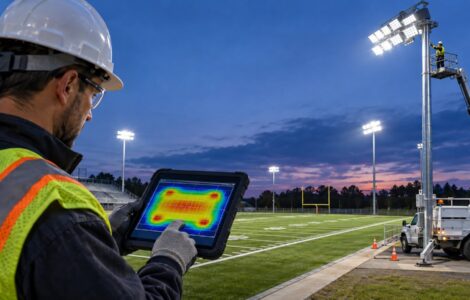
The calculation should show average, minimum and maximum illuminance, along with uniformity and the distribution map. A high average can hide weak edges. More total lumens will not correct that efficiently if the beam shape is the real problem.
Small Details That Continue to Cost Money
Light Outside the Playing Area
Every lumen sent onto a fence, wall or empty roof zone is paid for. Controlled optics often allow lower input power because a larger share of the output reaches the court or field. Ask for the full lux grid and boundary values rather than a total-lumen comparison.
An Unexplained Maintenance Factor
Lighting calculations normally reduce initial output to allow for dirt and lumen depreciation. If the maintenance factor is unrealistic, the installation may start brighter than necessary or fall short later. The proposal should state the value and the assumption behind it.
Difficult Service Access
A failed component above a court can close part of the venue. A high-mast repair may require a lift and a specialist crew. Accessible drivers and modular components will not prevent every failure, but they can shorten the visit and avoid replacing the full luminaire.
Incomplete Surge Protection
Outdoor sports sites are exposed to switching events and lightning-related surges. Fixture-level protection should be coordinated with the panel and site design. Repeated driver replacement and emergency access usually cost more than planning the protection correctly at the beginning.
Missing Aiming Records
A replacement fixture can match the original wattage and still create a dark area if its rotation or tilt is wrong. Keep the final aiming schedule with the maintenance records. It is a small document that protects the original lighting result.
Build Payback From Costs the Club Can Verify
Energy is only one part of payback. Maintenance, controls, rebates and installation cost also belong in the calculation.
| Payback input | Calculation |
| Annual energy saving | Old annual kWh minus new annual kWh |
| Annual electricity saving | Energy saving x tariff |
| Annual maintenance saving | Avoided lamps, drivers, lifts and labor |
| Net project cost | Installed cost minus rebates or incentives |
| Simple payback | Net project cost divided by annual savings |
If an upgrade costs $45,000 after incentives and the verified annual saving is $9,000, simple payback is five years. That number does not include financing, future tariff changes or court revenue lost during maintenance. Those items can be added separately if they are material to the decision.
What VKS Can Provide for a Club Project
VKS can model the actual court or field rather than estimate from floor area alone. The design package can include DIALux calculations, IES files, beam selection, installed power, control zoning and a fixture schedule tied to the real mounting positions.
The value of higher efficacy is lower input power. The value of controlled optics is that more of the light reaches the playing area. Multiple beam options help the design cover near, middle and far zones without forcing one distribution to do every job. Modular construction and accessible drivers can make later service less disruptive.
A club should receive a comparison it can check: expected lux, minimum values, uniformity, connected load and annual energy use under stated operating assumptions. That makes the saving visible before purchase and measurable after installation.
FAQs
Is the highest lm/W fixture always the best choice
No. Efficacy measures light output per watt; it does not show where the light lands. The optic must suit the court dimensions, mounting height and aiming distance.
How much can a club save by changing to LED sports lighting
It depends on the existing load and operating schedule. In the 48-fixture example, reducing each point from 455W to 220W saves about 56,851 kWh a year. Use the site's actual input power and hours for a useful estimate.
Should every court stay lit whenever the club is open
Usually not. Court-level or zone-level control can lower or switch off unused areas. Circulation and safety lighting still need to follow the operating plan and local requirements.
Does dimming reduce LED life
Compatible dimming usually lowers electrical and thermal stress. Confirm that the driver, protocol and minimum dimming level work together.
What information is needed for an energy estimate
The minimum useful set is fixture quantity, actual input power, operating hours, electricity tariff, court or field dimensions, mounting height and target lighting level. Maintenance records make the estimate more complete.
A Better Basis for the Purchase Decision
Use real operating hours, complete-luminaire data and a site-specific lighting model. Then add controls that match the booking pattern. That approach gives the club a defensible energy estimate without weakening the court experience.
VKS can provide the photometric files, DIALux model and installed-power comparison needed for that review. The club can replace the example tariff with its own rate and judge the project on numbers it can later verify.