How Far Can High Output LED Flood Lights Reach?
- VKS
- Sep 24, 2026
- Blog

High output LED flood lights can reach very far, but “far” is not a fixed number. In a real project, reach depends on mounting height, pole distance, beam angle, aiming direction, target lux level, glare limits, and the size of the area that needs useful light. A fixture may be visible from hundreds of meters away, yet still fail to deliver enough light for a stadium, port yard, airport apron, or sports field.
That is why professional buyers should avoid judging reach by wattage alone. A 600W floodlight with a narrow beam can project light farther than a 1200W floodlight with a wide beam. A higher pole can increase coverage, but it may also raise glare risk if the aiming angle is poor. For VKS Lighting, the real question is not simply how far a light can shine. It is how far it can deliver usable, comfortable, and controlled illumination.
Recent outdoor lighting discussions focus heavily on dark-sky protection, lower spill light, reduced glare, and smart dimming. Guidance for outdoor sports lighting now places more value on targeted beams, shielding, scheduling, and scene control. This trend makes optical design and lighting simulation more important than ever.
What Really Decides The Reach Of High Output LED Flood Lights?
The reach of high output LED flood lights is shaped by several connected factors. Power matters, but it is only one part of the answer. The same fixture can perform very differently when the pole height, beam angle, aiming direction, and target area change. A good lighting plan studies these points together.
Wattage And Useful Lumens
Wattage tells you how much power the fixture uses. It does not directly tell you how much useful light reaches the ground. LED efficacy, lens design, reflector shape, and driver quality all affect the final result.
For example, VKSLed high-power sports floodlights can offer strong output with system efficacy around 150-190 lm/W depending on the series. Our LED sports lighting range includes options for stadiums, football fields, tennis courts, padel sport venues, pickleball courts, race tracks, and recreational sports areas. In each case, the useful reach must match the sport, the pole location, and the required lighting class.
A buyer may ask, “can you still buy it?” when replacing older floodlights. Availability matters, but replacement should not be based on wattage alone. The new fixture should match the old project’s beam direction, mounting structure, electrical system, and lighting performance.
Beam Angle And Projection Distance
Beam angle has a direct effect on reach. A narrow beam concentrates light into a smaller area and can travel farther. A wide beam spreads light over a larger surface but loses intensity over distance.
Common beam choices include:
- 10°-20° for long throw from high poles
- 25°-40° for medium-distance sports lighting
- 60°-90° for broad coverage from lower heights
- Asymmetric beams for forward throw from field edges
- Roadway beams for paths, roads, and public areas
For large fields, one project may need several beam angles. A far-side target area may need a narrow beam, while a closer zone may need a wider or asymmetric distribution. This is normal in professional lighting design.
Mounting Height And Aiming Direction
Higher mounting positions can help floodlights reach farther, but they also make aiming more sensitive. If the light is aimed too high, it may cause glare, spill light, and upward light. If it is aimed too low, it may create bright patches near the pole and dark areas farther away.
For long-range projects, designers must study:
- Pole height
- Pole setback distance
- Target area size
- Fixture tilt angle
- Beam spread
- Observer positions
- Nearby roads, homes, or buildings
This is why reach should always be discussed with installation height and projection distance, not as a single product claim.
Why Average Lux Is Not Enough
Average illuminance is useful, but it cannot describe the whole lighting quality of a project. A field can have a high average lux level and still feel uncomfortable or unsafe if the light is uneven. Players may lose sight of a ball, drivers may face glare, and spectators may see bright hot spots.
Uniformity Across The Target Area
Uniformity shows how evenly light is distributed. In sports and large outdoor areas, poor uniformity can be more harmful than slightly lower brightness. Bright and dark bands make it harder to judge speed, distance, and movement.
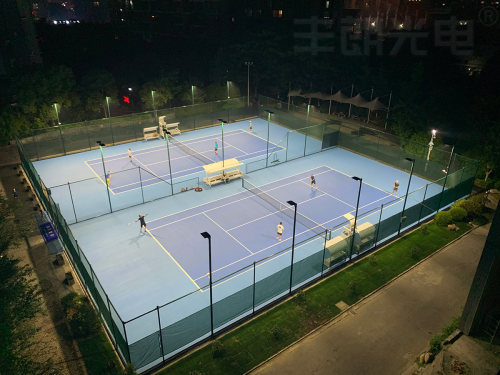
For led sports floodlights stadium visibility safety, uniformity is central. Football, hockey, tennis, and padel sport all require clear tracking of fast-moving objects. The same rule applies to ports and logistics yards where workers, vehicles, and equipment move at night.
Vertical Illuminance And Object Recognition
Horizontal lux measures light on the ground. Vertical illuminance helps people see faces, balls, vehicles, containers, and moving objects. For sports and security applications, vertical light is often just as important as ground brightness.
A stadium may need vertical illuminance for cameras and spectators. A port yard may need it for container identification and safe vehicle movement. A public square may need it for facial recognition and comfort. High output LED flood lights should be selected for the actual viewing task, not only the ground lux target.

Glare, Spill Light, And Uplight Are Different Problems
These three issues are often mixed together, but they are not the same. A professional lighting plan should treat each one separately. This matters because each problem needs a different solution, from optical shielding to aiming correction, dimming, or a different beam angle.
Glare
Glare happens when a bright source enters the viewer’s line of sight and causes discomfort or reduced visibility. In sports, glare can disturb players when they look upward or across the field. In ports, roads, and parking areas, glare can reduce safety for drivers and workers.
Low-glare design may include:
- Cut-off optics
- Shielding accessories
- Better fixture aiming
- Lower tilt angles
- Suitable mounting height
- Different beam distributions
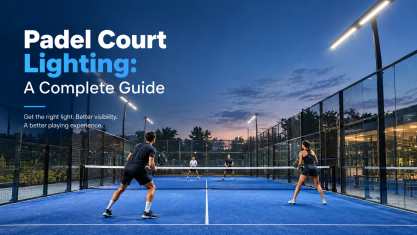
Correct padel court lighting is a good example. Indoor padel courts need comfortable low-glare light because players often look upward and react quickly. Outdoor sports fields need longer throw, stronger weather protection, and more control over spill light.
Spill Light
Spill light is light that falls outside the intended area. It may reach neighboring homes, roads, gardens, or dark natural areas. On large projects, spill light can create complaints even if the main site looks well lit.
VKS offers spill-control options such as full-cutoff optics, asymmetric beams, visors, and careful photometric design. The L03 Icon spill-light-control sports light is built for controlled outdoor sports lighting with asymmetric beam options and low uplight design.
Uplight
Uplight is light sent above the horizontal plane into the sky. It contributes to sky glow and wasted energy. Some projects now require strict control of upward light, especially near communities, airports, and environmentally sensitive areas.
A fixture with 0% upward light ratio or full-cutoff optics may help reduce this issue. But aiming still matters. Even a good fixture can perform poorly if installed at the wrong angle.
Product Types For Long-Range Lighting Projects
Different projects need different floodlight categories. A stadium, a seaport, a public square, and an indoor sports hall should not use the same logic. Product selection should begin with the project problem, then move to fixture type, beam angle, and control method.
High-Power Sports Floodlights
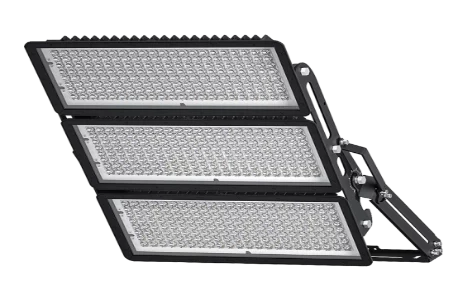
High-power sports floodlights are suitable for stadiums, large pitches, race tracks, and multi-purpose sports fields. They often use narrow, medium, wide, and asymmetric beams to cover different zones from different pole positions.
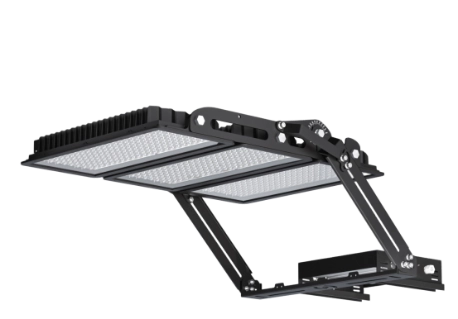
The G01 Oasis high-power LED sports floodlight is designed for large outdoor projects, with power options from 600W to 1800W, multiple beam angles, IP66 protection, and smart control options such as DALI and DMX512. It is a strong fit when long throw and controlled coverage are both required.
High Mast LED Lighting
High mast LED lighting is used when a large area must be lit from tall poles. This can include stadium surroundings, airports, ports, cargo terminals, industrial yards, and large parking areas. Because the lights are mounted high, beam control becomes very important.
Our LED outdoor high mast lighting options are useful for wide-area projects where fewer poles may need to cover greater distances. In led seaport lighting, for example, the system must reach across container yards while still limiting glare for operators and drivers.
Modular Floodlights For Industrial And Urban Areas
Modular floodlights are useful when a project needs different power levels or beam angles on the same site. A large logistics yard may use stronger fixtures for central work areas and lower-power lights for edges, roads, or loading zones.
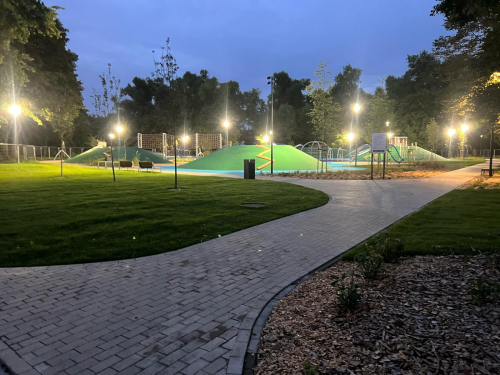
For city projects, led urban lighting can support roads, public squares, commercial surroundings, and parking areas. These urban LED lighting solutions are often used with floodlights so each zone receives the right level of light without over-lighting the whole site.
Material Features That Support Long-Term Reach
A floodlight’s first-day performance is not enough. Outdoor fixtures must keep stable output after years of heat, dust, rain, wind, and electrical stress. Material quality directly affects long-term brightness, safety, and maintenance cost.
Important material features include:
- Die-cast aluminum housing for strength and heat transfer
- Fin heat sink design for better cooling and lower weight
- PC lenses for accurate optical control
- Tempered glass for added protection on selected models
- Powder-coated finish for corrosion resistance
- IP66 sealing for outdoor rain and dust protection
- IK08 or IK10 impact protection for demanding sites
- 10KV or optional 20KV surge protection for electrical reliability
The L06S lightweight sports luminaire uses a fin heat sink and modular structure to reduce fixture weight while supporting strong thermal performance. This can help when high-output fixtures are installed on tall poles or retrofitted onto existing structures.
Why Lighting Simulation Should Come Before Product Selection
Lighting simulation should not appear as a last-minute drawing. It is the tool that helps decide which fixture, wattage, beam angle, quantity, pole position, and aiming direction will actually work.
A simulation can show:
- Average illuminance
- Minimum illuminance
- Uniformity ratio
- Vertical illuminance
- Glare risk
- Spill light beyond the boundary
- Fixture quantity
- Beam direction
- Pole shadow or blocked areas
- Different lighting scenes
At our VKS company, we treat simulation as part of the solution, not only as a sales document. VKS solutions are built around project conditions, so one project may use different wattages, beam angles, and aiming directions. A large stadium may combine narrow beams for distant zones and wider beams for nearby areas. A port may use high mast fixtures for work zones and urban fixtures for roads. A sports park may combine floodlights, pathway lighting, and solar lighting for support areas.

Main Application Industries
High output LED flood lights are used across many industries where long reach, safety, and stable night operation matter.
Common applications include:
- Stadiums and professional sports venues
- Football, rugby, hockey, tennis, pickleball, and padel sport facilities
- Airports, apron areas, and cargo terminals
- Ports, shipyards, and container yards
- Highways, intersections, and large parking lots
- Industrial plants and logistics centers
- Public squares, parks, and commercial areas
- Recreational sports centers and school fields
For surrounding access roads, gardens, and remote paths, LED solar lighting can support low-energy outdoor lighting where full high-output floodlighting is not necessary.
Conclusion
High output LED flood lights can reach long distances, but useful reach depends on more than wattage. Beam angle, pole height, aiming direction, optics, target lux, uniformity, vertical illuminance, glare control, spill light, and uplight all shape the final result. Narrow beams support long throws, while wider beams cover nearer areas. A single project may use different wattages and beam angles to match different zones. Strong materials such as aluminum housings, PC lenses, tempered glass, powder coatings, IP66 sealing, and surge protection help maintain long-term performance. For the best result, buyers should request lighting simulation before choosing fixtures. It is the clearest way to see whether the design will deliver the right light, in the right place, with less waste.
FAQs
Q: How do I choose high output LED flood lights for a large project?
A: Match pole height, beam angle, target lux, uniformity, glare limits, and site dimensions.
Q: Why is lighting simulation needed before buying floodlights?
A: It checks fixture quantity, aiming, beam angle, lux levels, uniformity, spill light, and glare risk.
Q: Can one project use different wattages and beam angles?
A: Yes, if simulation confirms balanced coverage, safe visibility, and suitable glare control.