Sports Lighting Contractor Guide From Design to Handover
- VKS
- Nov 12, 2026
- Blog
A sports lighting contractor rarely loses time because a fixture cannot turn on. The trouble usually starts with a missing coordinate, an optic that does not match the simulation, an assumed bracket size or a control decision made after the cable has been ordered.
Those gaps become site work. A crew waits for clarification, a lift returns for another visit, or the contractor has to explain why the measured result differs from the approved report. The supplier can prevent much of this by keeping the product data, photometric model and delivered equipment aligned from the first quotation through commissioning.
What a Sports Lighting Contractor Needs Before Pricing
Fixture quantity is only as reliable as the geometry behind it. Record the playing area, runoff zones, pole coordinates, mounting heights, crossarm dimensions, setbacks and nearby properties before the first calculation.
A retrofit needs more. Confirm the site voltage, breaker arrangement, available conductor capacity, bracket pattern, fixture weight limits and current aiming directions. Photographs help the conversation, but they do not replace measured dimensions.
Put these inputs on one sheet and attach it to the quotation. If the pole height or boundary later changes, everyone can see which assumption moved and why the price or lighting result needs to be revised. That is cleaner than trying to reconstruct the design basis after a discrepancy appears on site.
Translate Efficacy Into Connected Load
Compare complete luminaire output with complete luminaire input power. LED package efficacy excludes driver, optical and thermal losses, so it will overstate the performance of the finished fitting.
For a required output of 70,000 lumens per fixture, a 140 lm/W luminaire needs about 500W. A 170 lm/W luminaire needs about 412W. Across 32 fixtures, the connected-load difference is about 2.82 kW.
| Example input | 140 lm/W option | 170 lm/W option |
| Output per fixture | 70,000 lm | 70,000 lm |
| Approximate input power | 500W | 412W |
| Total for 32 fixtures | 16.00 kW | 13.18 kW |
| Connected-load difference | 2.82 kW lower |
At 2,400 operating hours a year, the difference is about 6,776 kWh. That saves the owner roughly $813 a year at $0.12 per kWh, or $1,355 at $0.20 per kWh.
The lower load may also help on a retrofit with limited spare panel or feeder capacity. It does not decide the cable or breaker size by itself. Voltage, grouping, inrush, voltage drop and local code still govern the electrical design.
Check Where the Lumens Go
Efficacy tells the contractor how much power is needed to create the lumens. The optic decides how many of those lumens are useful at the target.
A beam that is too wide may light fencing and neighboring property while leaving the far side weak. A beam that is too narrow can create a hotspot and force additional fixtures into the layout. Using narrow, medium and wide distributions where each is needed gives the designer room to fill distant and near zones without over-lighting the center.
If the approved optical design removes four fixtures, the contractor also removes four mounting points, cable drops, terminations, control addresses and aiming tasks. The labor value is site-specific, so use the local installed cost rather than a generic allowance:
Installation saving = avoided fixture quantity x installed labor and equipment cost per point
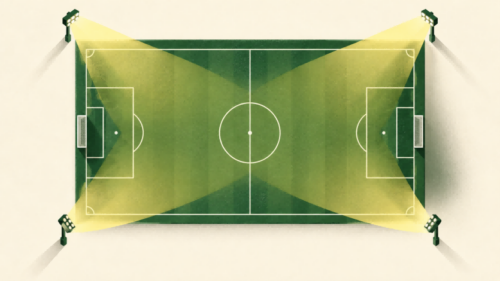
Fixture reduction should only be counted after the model confirms illuminance, uniformity, glare and spill light. The Football Field Lighting Guide explains why output, beam angle and pole geometry cannot be separated.
Make the Photometric Submittal Traceable
The consultant, contractor and supplier need to review the same design. A useful submittal identifies the exact fixture and optic, then ties every unit to a location and aiming instruction.
- Fixture model and optic code
- Input power and luminaire lumen output
- IES or LDT photometric file
- Pole coordinates and mounting heights
- Fixture quantity at each location
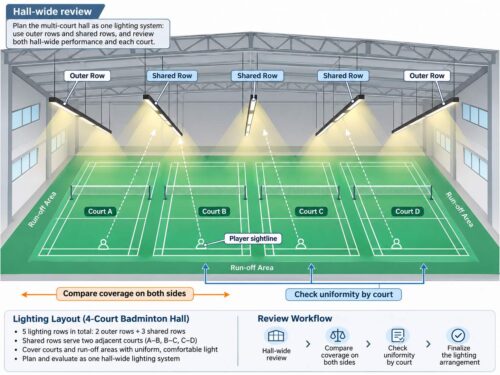
- Tilt, rotation and aiming point for each fixture
- Calculation grid and maintenance factor
- Average, minimum and maximum illuminance
- Uniformity and boundary spill results where required
Check the suffixes, not only the product family name. A different optic can sit in the same housing and draw the same watts while producing a different field result. The model code on the purchase order must match the code used in the photometric file.
VKS can provide IES files, DIALux calculations and fixture schedules so that quotation, approval and installation refer to the same configuration.
Electrical Checks for a Sports Lighting Contractor
Confirm voltage, frequency, power factor, inrush current, leakage current, dimming interface and surge-protection arrangement before the panel and control design is frozen.
Inrush deserves its own check. Running current may sit well below the breaker rating, yet simultaneous driver startup can cause nuisance trips. Grouping and switching sequence should follow the electrical designer's calculation and the driver's tested characteristics.
Outdoor surge protection also needs coordination. Protection inside the luminaire is one layer. It does not replace panel-level protection, site grounding or the rest of the electrical strategy.
Survey the Bracket as Carefully as the Circuit
On a retrofit, measure the tenon diameter, crossarm hole pattern, available tilt range and clearance around the driver compartment. Record fixture weight and effective projected area for the structural review.
A fitting can bolt onto the bracket and still be impossible to aim as designed. Handrails, adjacent luminaires and crossarm members may block rotation. The shop drawing should show the full aiming envelope, not only the final static position.
Changes in fixture quantity, shape or position can alter pole loading. The responsible engineer should confirm structural suitability. A supplier's bracket drawing is useful input, but it is not a substitute for that approval.
Give Each Fixture One Identity
Every fixture should carry a unique code. Put the same code on the drawing, carton, luminaire label and commissioning sheet. The installer should be able to move from the packing list to the correct pole without opening several boxes to find an optic.
The aiming schedule should include a target point, tilt and rotation. “Aim toward the field” leaves too much interpretation. If clear labels and instructions save 20 minutes on each of 24 fixtures, one installer saves eight hours. A two-person lift crew may save more labor because both people are tied to the adjustment process.
Angle scales and pre-aiming marks make the first setup faster, but commissioning still has to verify the grid and the relevant player or camera views. A technically correct angle can be lost if the bracket was installed at a different reference orientation.
Set the Control Scope Before the Drivers Are Ordered
Simple contactors, 0-10V, DALI and DMX do not use the same drivers or cabling. Confirm the interface early, then write down who supplies the control panel, gateway, programming and ongoing support.
The owner also needs a short sequence of operation. Training, competition, cleaning and standby modes should have stated output levels. If booking integration or remote monitoring is required, it belongs in the scope before release. Otherwise, the control package becomes a boundary dispute between the lighting supplier, controls contractor and electrical contractor.
Pack for the Installation Sequence
Repeated fixtures are not interchangeable when their optics and locations differ. Packing everything together shifts sorting and verification to site, where the labor is more expensive and the schedule is less forgiving.
Organize cartons and packing lists by pole, court or installation zone. Keep optic codes visible after unpacking. Separate brackets, control accessories and spare parts so the crew can find them without disturbing the main installation sequence.
Imported equipment also needs a realistic release date. Production, testing, transport and customs should start from approved drawings, not from an early fixture count that is still changing.
Design the First Maintenance Visit Before Handover
The owner may not need service for years, but access still affects the value of the installation. Check whether a driver, surge device or LED module can be replaced without removing the whole luminaire. Record the tools and access method required.
Provide a spare-parts list that identifies the electrical version and optic, not only the housing family. On a high mast or above an indoor court, avoiding one unnecessary lift visit can matter more than the price difference between components.
Modular construction cannot eliminate maintenance. It can limit what needs to be replaced and shorten the time the area is unavailable.
Details That Commonly Become Change Orders
| Missed detail | Site effect | Prevention |
| Incorrect pole coordinates | Measured lux differs from the model | Survey and sign off coordinates |
| Different optic supplied | Dark areas, hotspots or spill light | Match the purchase code to the photometric file |
| Control interface confirmed late | Driver or cabling change | Approve the control sequence before release |
| Bracket geometry assumed | Drilling, adapter or access delay | Measure tenon and crossarm details |
| No fixture-level aiming plan | Extra lift time and inconsistent results | Issue labels, targets and angles |
| Site surge strategy omitted | Higher failure risk | Coordinate fixture and panel protection |
None of these items looks large on a drawing. On site, each can trigger another crew visit, another approval cycle or another lift mobilization.
What VKS Can Provide to a Sports Lighting Contractor
VKS can support a sports lighting contractor with IES files, DIALux reports, beam selection, fixture schedules, aiming information and packing organized by installation location. The purpose is to keep the product supplied consistent with the design approved.
High-efficacy luminaires can reduce connected load and annual energy use. Multiple optical distributions help place light in near, middle and far zones. Modular construction can make later driver or module service more direct. Control and surge-protection options can be reviewed before release so they match the specification.
The contractor remains responsible for local code, structural approval and installation. Our role is narrower and practical: provide consistent product data, a traceable photometric package and equipment arranged for the site sequence.
For procurement checks, see Why Source China LED Sports Floodlight for Stadium Projects and How to Choose an LED Floodlight Stadium Manufacturer.
Frequently Asked Questions
What site information is needed for a sports lighting calculation
Provide the playing-area dimensions, pole or ceiling coordinates, mounting heights, setbacks, target lux and uniformity, nearby boundaries and any camera requirement. Retrofit projects also need bracket and electrical data.
Can a higher-efficacy fixture reduce cable size
It can reduce connected load, but cable and breaker selection also depends on voltage, distance, inrush, grouping, voltage drop and local code. The electrical designer must confirm the final size.
Why must the optic code match the IES file
The optic controls the beam shape. Changing it can alter minimum illuminance, uniformity and spill light even when the housing and wattage stay the same.
How can contractors reduce aiming time
Use fixture-level labels, pole-by-pole packing, target coordinates, angle scales and an approved aiming schedule. Commission the result against the calculation rather than relying on visual alignment alone.
What belongs in the handover package
Include the approved lighting report, fixture schedule, final aiming record, control sequence, product data, warranty information and spare-parts list.
What the Contractor Should Be Able to Verify
Before release, a sports lighting contractor should be able to trace every supplied fixture back to the photometric model and every site position back to an aiming instruction. That level of control removes many of the small uncertainties that become expensive during installation.
VKS can provide the design files, optical options and organized supply package for that process. The result is easier to price, quicker to install and simpler to test against the approved lighting design.