Football Field Lighting Guide: Lux, Uniformity, Glare and Layout
- VKS
- Oct 16, 2026
- Blog
Football fields are large, and players must follow a fast-moving ball over long distances. Their viewing direction also changes throughout the match. For these reasons, football field lighting is more demanding than general outdoor lighting.
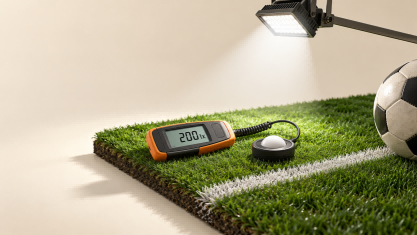
Many projects begin with two questions: how many watts are needed, and how many lux can the system produce? Those numbers matter, but they do not describe the full result. A field can reach an average of 300 lux while the center measures more than 500 lux and the corners remain close to 120 lux. Another design may have the same average but provide much steadier light across the whole playing area. Players will notice the difference immediately.
A strong design starts with the level of play. It then considers the field size, pole positions, mounting height, beam angles and nearby properties. Fixture wattage should be a result of this process, not the starting point.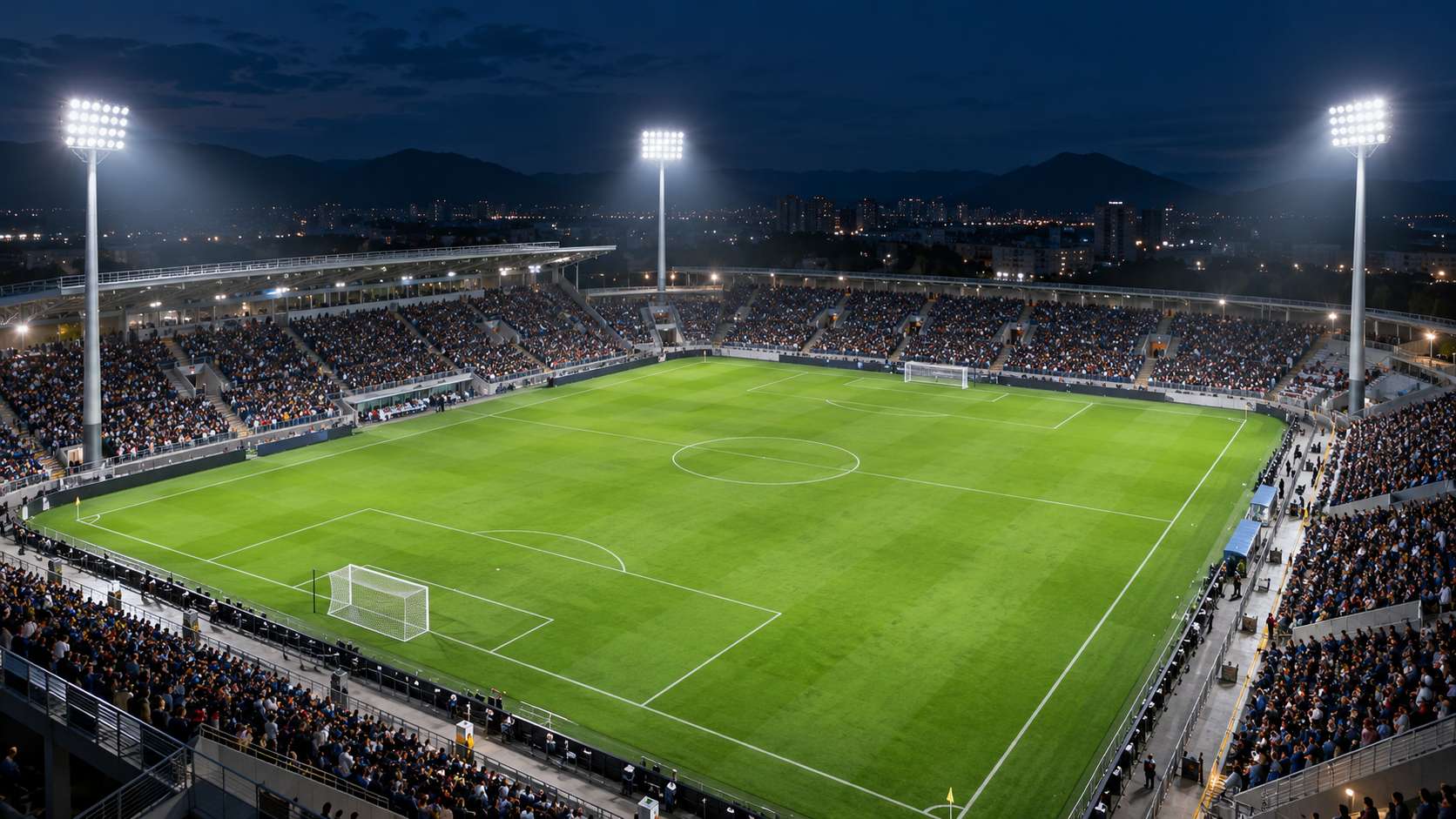
How Many Lux Does a Football Field Need?
The target illuminance depends on how the field will be used. A school training pitch, a community field, a club venue and a professional stadium do not need the same lighting level.
EN 12193 is often used as a reference for outdoor football projects. The table below shows common starting points. Local rules, competition requirements and broadcast needs should always be checked before the design is approved.
| Playing level | Average horizontal illuminance | Uniformity Emin/Eavg | Typical use |
| Class III | 75 lux | 0.50 | Training, schools and recreation |
| Class II | 200 lux | 0.60 | Regional and club competition |
| Class I | 500 lux | 0.70 | High-level competition |
Many community and amateur club fields aim for about 200 to 300 lux with good uniformity. Professional and televised venues need more detailed checks. They must often provide enough vertical light on players, the ball and the directions viewed by cameras.
Horizontal and Vertical Illuminance Serve Different Needs
Horizontal illuminance, or Eh, measures the light reaching the playing surface. It affects how clearly players can see the grass, boundary lines and ground-level action.
Vertical illuminance, or Ev, measures light on vertical surfaces such as players' faces and the ball in the air. Horizontal illuminance is usually the main concern for training fields. For video recording or broadcast, a bright playing surface is not enough. The lighting must also support clear images from the main camera positions.
Why Uniformity Matters as Much as Average Lux
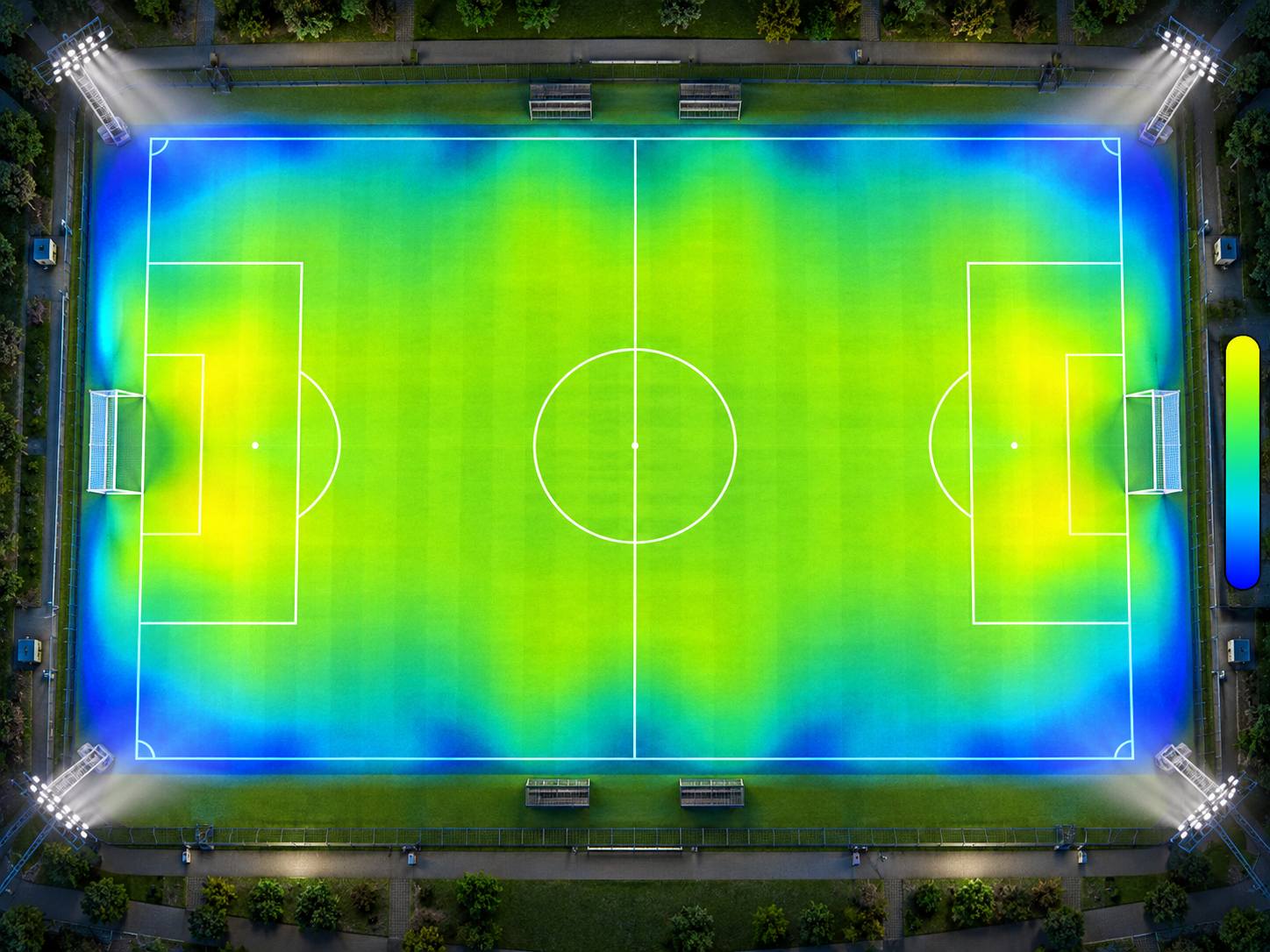
Average illuminance is easy to compare, but it can hide large dark areas. If the midfield reaches 500 lux while the goal areas measure 150 lux, players move through strong changes in brightness. Their eyes must keep adapting, which makes the ball harder to track.
Uniformity is commonly expressed as the minimum illuminance divided by the average illuminance:
U0 = Emin / Eavg
If the average is 300 lux and the minimum is 210 lux, U0 is 0.70. In many projects, raising the lowest values gives a better result than adding more light to areas that are already bright.
A lighting report should show average, minimum and maximum illuminance, Emin/Eavg uniformity and the full illuminance distribution. For more guidance on comparing sports lighting systems, read Tips for Choosing the Right Sports Lighting.
What Causes Glare on a Football Field?
Football floodlights are powerful and often use narrow beams to throw light over long distances. Glare becomes a problem when poles are too low, aiming angles are too steep or bright fixtures sit inside a player's normal line of sight.
Players often look upward to follow a high ball. If a floodlight appears directly behind the ball, visual contrast drops and the ball may disappear for a moment. Goalkeepers are especially sensitive because they frequently look toward high balls near the goal area.
Lower Wattage Does Not Automatically Fix Glare
Reducing power also reduces useful light. A better solution is to improve the geometry of the system. This may involve raising the mounting height, changing aiming points, balancing narrow and wide beams or moving light away from key viewing directions.
Good stadium floodlights do more than produce high lumen output. They place light where it is needed and limit light where it causes discomfort.
Fixture Position Is Part of Glare Control
Locations behind the goals require special care. Attackers and goalkeepers often look in this direction, so fixtures and aiming angles should avoid the most sensitive sightlines. Glare control begins when pole positions are planned. It should not be left until commissioning.
How Pole Height, Position and Beam Angle Affect Lighting
The same floodlight can perform very differently at different mounting heights. A low pole places the fixture closer to the field, but the light must be aimed at a steeper angle to reach the far side. This often increases glare, hotspots and spill light.
A higher pole allows light to reach the field at a more comfortable angle. It also demands stronger long-distance optical control. Mounting height, fixture output and beam angle must therefore be selected together.
Four-Pole and Six-Pole Layouts
A four-pole system usually has lower infrastructure costs, but every pole must cover a larger area. This places more demand on fixture output, narrow-beam optics and aiming accuracy.
Six or more poles provide light from more directions. They can improve uniformity and reduce shadows, but they increase structural, electrical and installation costs. The right choice depends on the complete system: pole count, pole height, fixture count, wattage, optics, construction cost and final lighting performance.
For venues that also host athletics, rugby or other sports, see Which Athletic Field Lighting Fits Multiuse Venues?.
One Field Usually Needs More Than One Beam Angle
Areas close to a pole can use a wider beam. Mid-range areas often need a medium beam, while the far side may require a narrow beam with higher center intensity.
Using one beam angle across the whole field often creates bright zones near the poles and weak light at the far side. Adding more power may make the near areas even brighter without solving the main problem. A better design assigns different beams to near, middle and far zones.
How to Choose LED Football Field Lights
Wattage is only one part of fixture selection. The following points have a larger effect on long-term performance.
1. Compare Useful Light, Not Only Lumens per Watt
A 180 lm/W fixture does not always produce more useful light on the field than a 160 lm/W fixture. If the beam misses the target or cannot reach the far side, the higher efficacy provides little value. Check how much light reaches the calculation area at the planned mounting height.
2. Use an Optical Range That Matches the Site
Large fields often need narrow, medium and wide distributions in the same design. A sports lighting range with several optical options is easier to optimize than a fixture with one general-purpose beam.
3. Check Outdoor Reliability
High-mast fixtures are expensive to access. A single replacement may require lifting equipment and extra labor. Check the IP and IK ratings, surge protection, thermal design, driver quality, optical material and expected service life.
4. Consider Modular Construction
Modular fixtures allow flexible power configurations and simpler servicing. If individual modules can be aimed separately, one fixture can distribute light across near, middle and far zones more accurately. For more purchasing guidance, see Why Source China LED Sports Floodlight for Stadium Projects?.
Why Football Field Lighting Needs a Professional Simulation
An area-and-lumen calculation gives only a rough estimate. A useful lighting model should include the field dimensions, pole coordinates, mounting heights, fixture model, IES files, wattage, optics, orientation, aiming points and maintenance factor.
DIALux or similar software calculates illuminance at each point on the field. This makes it possible to find dark areas, hotspots and poor aiming before installation.
Simulation Shows Where the Light Should Go
Reaching an average of 200 or 300 lux is often easy with enough power. Reaching that level with U0 close to 0.70 is harder. The designer must raise the lowest values without creating new hotspots.
Sometimes another fixture is not needed. A change in aiming point or beam angle can improve uniformity while keeping the same installed power. This is the main value of a detailed simulation.
Five Common Football Lighting Mistakes
Comparing Fixtures by Wattage Alone
A 1000W rating does not show how the field will look. Efficacy, optics, mounting height and aiming all affect the result.
Checking Only Average Illuminance
An average of 300 lux does not mean every area is close to 300 lux. Minimum illuminance and the distribution map are just as important.
Using One Beam Angle Everywhere
Large fields have clear near, middle and far zones. One beam rarely covers all of them well.
Using Low Poles for Long Throws
Low mounting heights often require steep aiming angles. This raises the risk of glare and spill light.
Ignoring Nearby Properties
Football fields are often close to homes, roads or public areas. Spill light and upward light should be reviewed during design to reduce complaints and later changes. For a broader explanation of direction, illuminance and visual quality, read Lighting Passion on the Field: An In-Depth Analysis of Key Elements in Sports Lighting.
A Practical Football Lighting Design Process
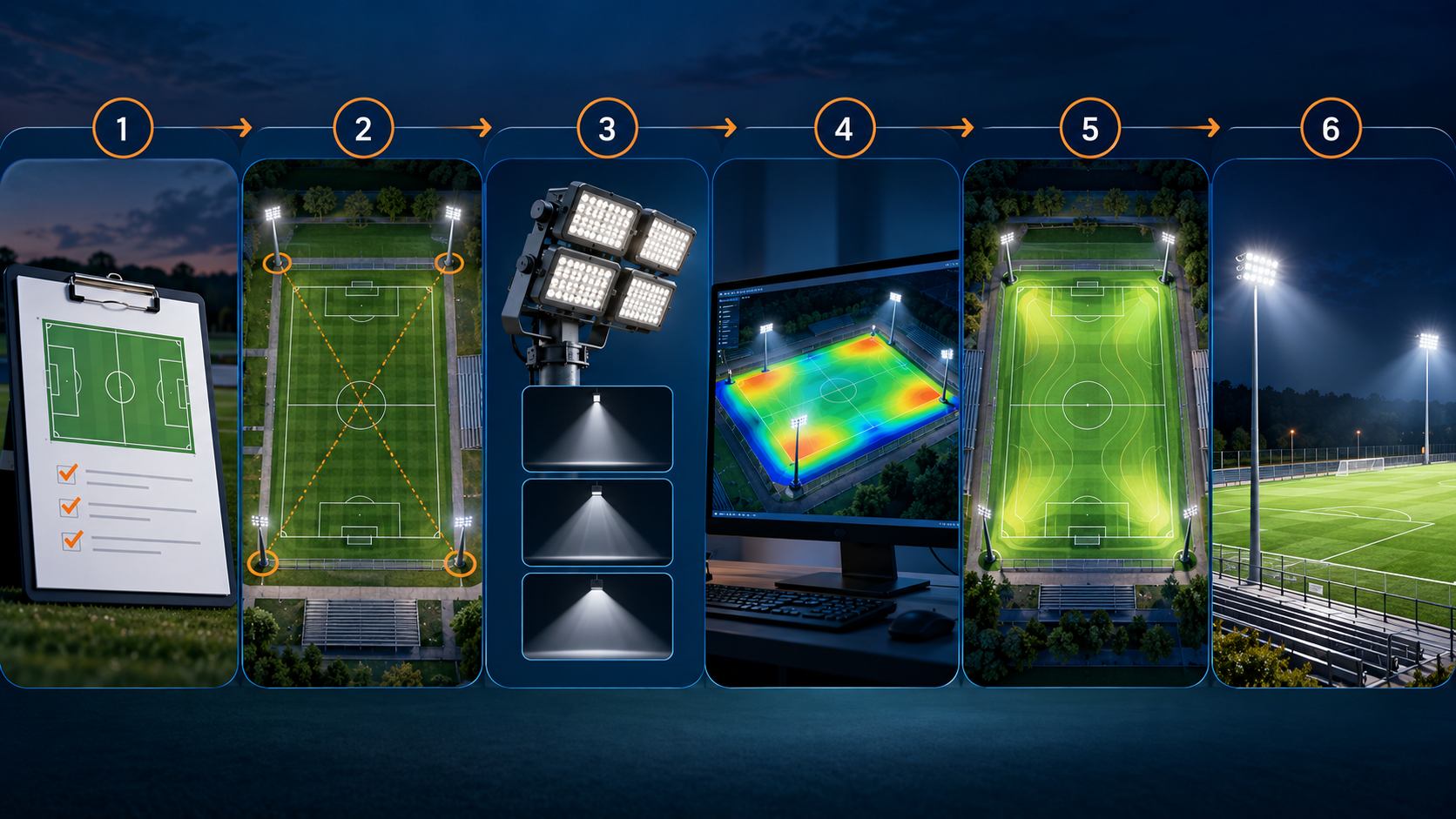
Start with the field size, playing level, target illuminance and uniformity. Confirm whether the venue needs video recording or broadcast lighting. Then record the number, position and height of the existing or proposed poles.
Build the first model with suitable beam angles. Review the minimum illuminance, uniformity, distribution and glare risk before fixing the fixture count. Adjust aiming points and optics, then compare total power, energy use and installation limits.
Fixture quantity and wattage should come from this process. They should not be chosen before the layout is tested.
FAQ: Football Field Lighting
How many lux does a football field need?
It depends on the playing level. Training and recreation fields can use lower levels, while club and competition venues need more light and better uniformity. EN 12193 values of 75, 200 and 500 lux are common reference points, but local standards and the actual use of the field should guide the final target.
What is a good uniformity level for a football field?
The requirement changes with the level of play. For club and higher-level fields, Emin/Eavg of 0.60 to 0.70 or above creates a more stable visual environment than a high average with dark areas.
What wattage should LED football field lights use?
There is no fixed answer. Sports floodlights may range from a few hundred watts to more than 1000W. Pole height, distance, beam angle, target lux and fixture count all affect the required wattage.
Why are narrow beams used on football fields?
Some fixtures must throw light several dozen meters. Narrow beams provide stronger center intensity at long distances. They should be combined with medium and wide beams to avoid hotspots.
Can LED football lights be dimmed?
Yes. Systems using 1-10V, DALI or other controls can provide separate settings for training, regular matches and higher-level events. This reduces energy use when full output is not needed.
Can metal halide lights be replaced one for one with LED fixtures?
A direct one-for-one replacement is risky. LED optics differ from traditional floodlights, so the same number of fixtures may change uniformity, glare and coverage. Keep the existing pole data and run a new lighting simulation before selecting the LED system.
Conclusion
Good football field lighting is not created by adding more power. It comes from the balance between illuminance, uniformity, glare, pole geometry and beam control.
For a new field, complete the lighting simulation before the poles are built. For a retrofit, measure the existing pole positions, heights and electrical capacity first. VKS can use this information to prepare a DIALux simulation, IES files and a fixture schedule before purchasing and installation begin.