Why Source China LED Sports Floodlight for Stadium Projects?
- VKS
- Sep 11, 2026
- Blog
People no longer judge stadium lighting just by its brightness. Today, project owners look at other factors. They care about energy use, glare, and daily maintenance. Light spill and smart control matter too. Long-term reliability is also a major focus. A good system must help athletes perform well. It should also support spectators, officials, and TV broadcasters. At the same time, the lights must respect nearby communities.
Because of this, many global buyers pick a China LED sports floodlight for their stadium projects. The country offers a complete LED manufacturing supply chain. It also provides strong engineering skills and flexible production. Yet, the true value goes beyond just the location. Buyers need a partner who truly understands sports lighting. This supplier must offer durable materials. They should also guide the project from the first lighting design to the final installation.
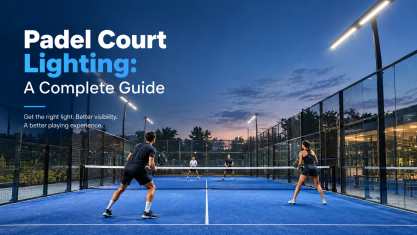
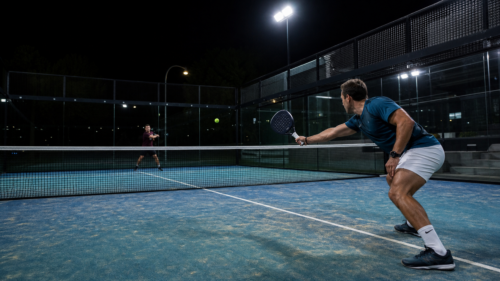
Padel sport is becoming very popular. Community stadiums, school facilities, and multiuse venues are growing too. This growth is changing what projects need. In 2026, padel keeps expanding around the world. The International Padel Federation reports 38 million active players. They also list 100 affiliated national federations. Meanwhile, responsible sports lighting gets much more attention. Badly aimed floodlights cause real problems. They create bad glare, spill light, and unwanted sky glow.
Why China Is A Practical Source For Stadium Lighting
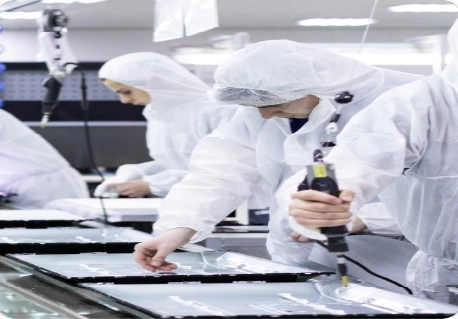
Buying from China gives you more than just a lower price. A skilled maker brings many steps together. They handle LED research, optical design, and housing production. They also manage driver matching, testing, and project service. Everything stays in a single supply chain. This setup cuts down on communication issues. It also makes adjusting the lighting system for the actual field much easier.
Stadium contractors, lighting distributors, and facility owners face a bigger question. The issue is not just where the fixture is built. Instead, they must know if the supplier delivers stable quality. The factory must provide suitable optics and clear technical papers. Dependable support during the whole project is just as vital.
Integrated Manufacturing And Project Support
A professional sports lighting manufacturer China buyers can trust needs solid experience. They should show strong skills in several key areas:
- LED product design and optical development
- Die-cast aluminum housing production
- Heat dissipation and thermal testing
- Driver and control system matching
- Lighting simulation and photometric reports
- Aging tests, electrical tests, and final inspection
- Customized brackets, beam angles, and control options
VKSLed has more than 13 years of experience in LED lighting manufacturing and provides sports lighting design, simulation, optical selection, and technical project support. Our work covers small recreational courts as well as large stadiums, race tracks, airports, cargo terminals, and other outdoor facilities.
Better Control Of Cost And Specification
A direct factory relationship also makes specification changes easier. For example, a project may require a different beam angle, mounting bracket, housing color, surge protection level, or dimming method. Working directly with the manufacturer can shorten the communication process.
VKS solutions are developed for different project conditions rather than one fixed lighting pattern. This is especially useful when a stadium includes a main field, training ground, parking area, public plaza, and surrounding roads.
Materials That Support Long-Term Stadium Performance
Outdoor stadium luminaires work in difficult conditions. Rain, dust, strong sunlight, heat, wind, vibration, and electrical surges can all affect performance. Material selection therefore has a direct effect on service life, maintenance work, and lighting stability.
Aluminum Housing And Heat Dissipation
Die-cast aluminum is widely used for outdoor sports floodlights because it is strong, corrosion-resistant, and effective at transferring heat away from the LED components. Good thermal management helps reduce light decay and protects the internal driver during long operating periods.
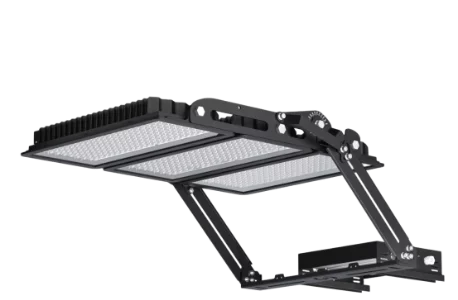
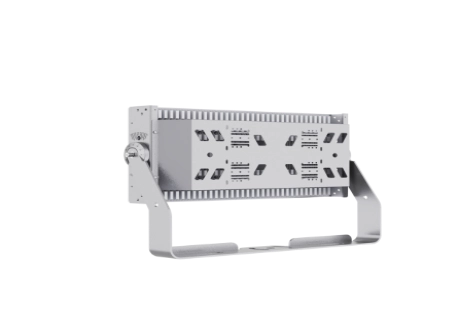
Some high-output VKS products use fin heat sink structures. The larger heat dissipation area helps maintain stable operating temperatures while reducing fixture weight. This is valuable for high mast stadium lighting, where installation equipment, pole loading, and maintenance access must all be considered.
PC Lens And Tempered Glass
The lens controls the shape and direction of the light beam. A high-quality PC lens can support precise optical distribution, while tempered glass adds protection for demanding outdoor applications. These materials must remain clear and stable over many years.
For stadium projects, material performance should be reviewed together with:
- IP protection against dust and water
- IK protection against impact
- Surge protection for unstable electrical conditions
- Powder-coated surface treatment
- Operating temperature range
- Expected L70 service life
The VKS LED sports lighting range includes outdoor sports luminaires and indoor court lights for football, rugby, tennis, padel, pickleball, basketball, hockey, swimming pools, and multiuse sports facilities.
Main Types Of LED Floodlights For Stadium Projects
Different stadium zones require different lighting products. A professional football field may need high-output long-throw luminaires, while an indoor court needs lower glare. Training fields, parking areas, and walkways may require separate lighting levels and beam patterns.
High-Output LED Stadium Floodlights
An LED stadium floodlight is designed for large fields, tall mounting positions, and demanding visual conditions. It normally uses narrow, medium, or asymmetric beams to direct light toward the playing surface.
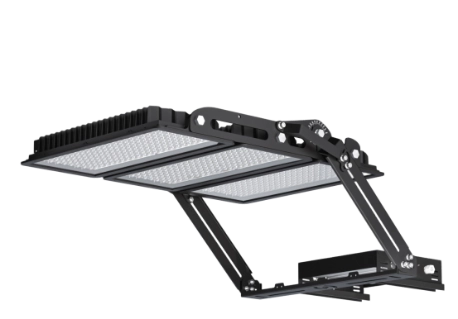
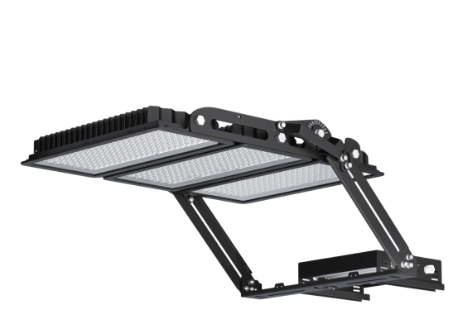
The VKS L05S high-output stadium light supports 500W, 600W, 1000W, 1200W, 1500W, and 1800W configurations. Its modular design allows each module to be aimed separately, giving installers more control over field uniformity and reducing the number of fixtures required for some projects.
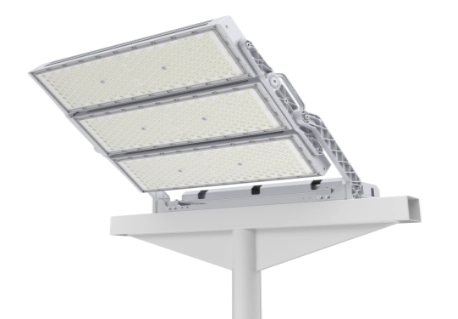
This type of fixture is suitable for:
- Professional football and rugby stadiums
- Athletics tracks
- Large training grounds
- Cricket and hockey fields
- Race tracks
- Airports and cargo terminals
Modular High Mast Floodlights
High mast lights are used when a wide area must be covered from tall poles. They are common in stadium surroundings, parking zones, ports, logistics yards, and large public facilities.
VKS outdoor and high mast lighting includes modular floodlights with symmetric and asymmetric beam options. Depending on the project, these fixtures can be used for long-distance illumination, perimeter lighting, access roads, and large outdoor areas.
The key benefit is flexibility. A modular system can be adjusted for different power levels and field zones, helping project teams balance output, pole height, installation space, and maintenance needs.
Low-Glare Lighting For Indoor Courts
Indoor sports have a different visual challenge. Players often look upward, and direct glare can affect concentration and comfort. This is especially important in padel sport, badminton, pickleball, and indoor tennis.
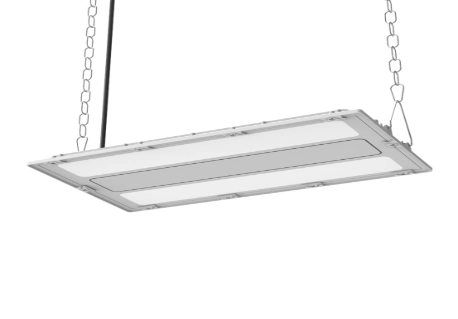
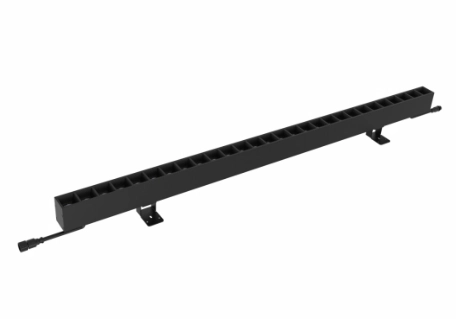
Low glare sports lighting should provide even light without creating bright points in the player’s normal sightline. VKS indoor linear sports lights use multiple beam distributions and low-glare optical designs for indoor court environments.
The result is a calmer visual field, fewer distracting reflections, and better comfort during long training sessions or competitions.
Core Advantages Of LED Sports Floodlights
The practical question behind the search phrase “led sports floodlights stadium visibility safety” is simple: can players and spectators see the action clearly without excessive glare or dark areas?
A good LED system should offer more than high lumen output. It should provide useful light in the right places.
Precise Optics And Better Uniformity
Beam angle selection affects field uniformity, vertical visibility, and spill control. Narrow beams can reach distant areas from high poles. Asymmetric beams can direct light toward the field while reducing light behind the pole.
VKS sports products offer multiple beam angles for different mounting heights and venue layouts. Our engineering team can create lighting simulations to review average illuminance, uniformity, aiming positions, and potential glare before installation.
This design stage is essential because adding more power cannot correct a poor optical layout.
Smart Controls And Energy Management
Modern stadiums are used for many activities. Training may require less light than a televised match. Maintenance crews may need only limited illumination, while event days may require full output.
Smart stadium lighting controls such as 1-10V, DALI, and DMX512 allow operators to create different lighting scenes. The system can also divide the venue into control zones, so unused areas are not fully illuminated.
This approach supports lower energy use and makes the venue easier to manage. World Athletics also highlights LED floodlights and efficient energy systems as part of better stadium energy management.
Reduced Spill Light And Community Impact
Outdoor sports facilities are often close to homes, schools, parks, and roads. Poorly controlled lighting can disturb nearby residents and affect the night environment.
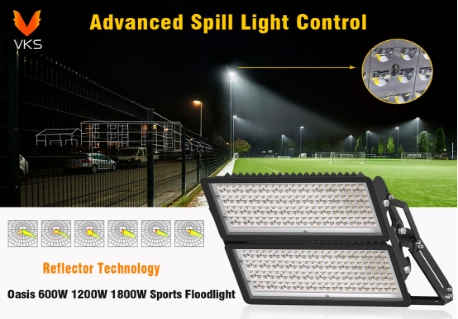
Responsible sports lighting programs now focus on zero or limited uplight, accurate aiming, automatic shutoff, dimming, and separate control zones. DarkSky guidance, for example, calls for no light above the horizontal plane for non-aerial sports fields and promotes dimming from 25% to 100% according to different uses.
VKS floodlights can be specified with low-spill optical designs, including full-cutoff options and 0% upward light ratio on selected models.
Applications Beyond The Main Stadium
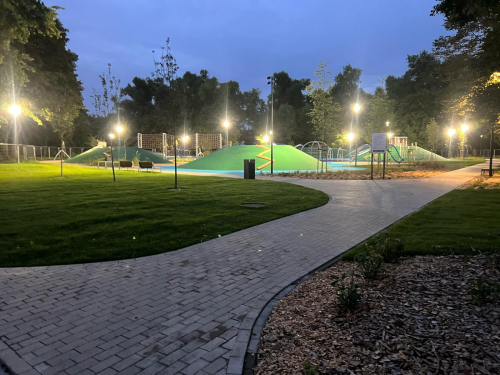
A stadium project rarely ends at the field. Visitors also need safe routes, clear parking areas, illuminated entrances, and comfortable public spaces. These surrounding zones should use suitable fixtures rather than the same high-output floodlight everywhere.
VKS offers LED urban lighting for roads, parking areas, plazas, gardens, commercial spaces, and public zones. For remote paths, parks, and areas where electrical wiring is difficult, LED solar lighting can provide a practical extension to the venue lighting plan.
Typical applications include:
- Football and rugby stadiums
- Athletics and race tracks
- School and university sports fields
- Community recreation centers
- Padel and pickleball clubs
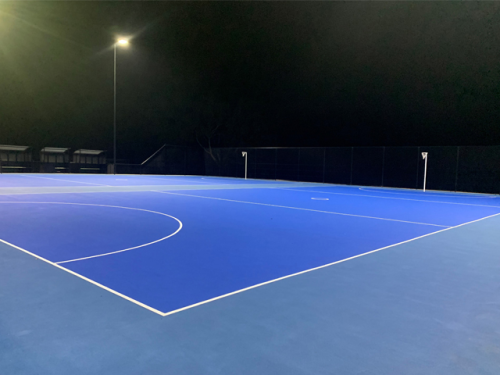
- MUGA courts and training facilities
- Stadium parking lots and access roads
- Airports, seaports, and cargo terminals
- Public plazas and outdoor event spaces
This wider product structure allows the vks company to support a complete outdoor lighting project, rather than supplying only the main field fixtures.
How To Select The Right Supplier
Before placing an order, buyers should review the full technical and service package. A low unit price cannot compensate for poor uniformity, difficult maintenance, or unsuitable beam angles.
Check whether the supplier can provide:
- Photometric files and lighting simulation
- Clear power and efficacy data
- Beam angle choices
- IP66 and impact protection options
- Surge protection details
- Control compatibility
- Installation and aiming guidance
- Warranty terms and spare parts support
- Factory inspection and product testing
VKS Sports combines product manufacturing, lighting design, project support, and customized engineering. Our goal is to help buyers select the right fixture for each zone, from the main stadium bowl to the final access road.
Conclusion
Sourcing a China LED sports floodlight can give stadium projects access to mature manufacturing, flexible specifications, strong optical design, and complete project support. The best results come from choosing a supplier that understands the connection between materials, beam control, glare, safety, energy use, and maintenance. High-output modular floodlights are suitable for large fields and high mast applications, while low-glare linear lights support indoor courts and padel venues. With smart controls, accurate aiming, and suitable urban or solar lighting around the site, VKS helps create stadium environments that are safer, more comfortable, and ready for long-term use.
FAQs
Q: What wattage is suitable for stadium floodlights?
A: Common options range from 500W to 1800W, depending on field size and lighting class.
Q: Can LED sports floodlights reduce glare?
A: Yes. Precise optics, asymmetric beams, shielding, dimming, and correct aiming can reduce glare.
Q: What factors should be considered when selecting LED sports floodlights?
A: The main factors include the sport and field size, mounting height, required illuminance, uniformity, beam distribution, glare control, and the arrangement of the poles or mounting positions. Fixture wattage should be selected based on the overall lighting design rather than used as the starting point.
Q: How do I choose the right beam angle for a sports lighting project?
A: Beam selection depends mainly on mounting height, distance to the playing area, pole position, and the required light distribution. Narrower beams are generally useful for longer throw distances, while wider or asymmetric distributions may be more suitable for closer or specific areas. A lighting simulation is recommended before finalizing the beam angle.
Q: Why is lighting simulation important for sports facilities?
A: A lighting simulation allows the project team to evaluate illuminance, uniformity, fixture quantity, aiming positions, and potential glare before installation. It can also help identify unsuitable beam angles or pole arrangements early, reducing the risk of excessive wattage or uneven lighting.
Q: How can LED sports floodlights help reduce glare?
A: Glare control depends on more than the luminaire itself. Appropriate beam distribution, mounting height, aiming angle, fixture positioning, and shielding can all help reduce glare. For sports facilities, these factors should be considered together during the lighting design process.
Q: What information is needed to prepare a sports lighting simulation?
A: Typically, the lighting designer needs the field or court dimensions, pole or mounting positions, mounting heights, surrounding structures where relevant, and the required lighting performance. With this information, the appropriate fixture, power, beam distribution, quantity, and aiming arrangement can be evaluated.
Q: Can VKS provide lighting design and product recommendations?
A: Yes. VKS can support projects with fixture selection, optical selection, lighting simulation, and technical recommendations. The solution is developed according to the actual project conditions rather than using one fixed fixture configuration for every venue.
Q: Can sports lighting be dimmed or integrated with a control system?
A: Depending on the selected driver and project requirements, control options such as 1-10V, DALI, or DMX512 can be considered. Different lighting levels can be used for training, competition, maintenance, and other operating conditions to improve energy management.