How Many Lux Does a Football Field Need?
- VKS
- Oct 28, 2026
- Blog
There is no single lux value that fits every football field. A training pitch, community facility, club venue and televised stadium have different visual tasks and different compliance requirements. The right target begins with the approved competition class and local rule set, then accounts for field size, pole geometry, fixture optics and any camera requirement. Average horizontal illuminance is the most familiar number, but it is only one part of a usable lighting brief.
This article explains how to set a practical lux target and what to check before a supplier fixes the fixture count. For a wider discussion of poles, glare, optics and layout, read theFootball Field Lighting Guide: Lux, Uniformity, Glare and Layout
Start With the Intended Use of the Field
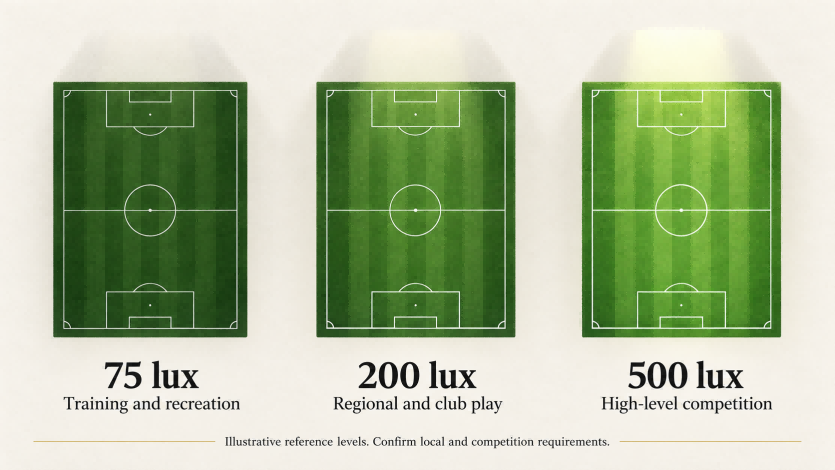
Use drives the illuminance target. A school or recreational field usually needs enough light for safe movement, ball tracking and ordinary training. A club venue needs a more consistent visual environment for faster play and spectators. High-level competition may require stricter uniformity, glare control and vertical illuminance for players, officials and cameras. A project should confirm its governing body requirements before using any table as a specification.
| Typical use | Reference average horizontal illuminance | Reference uniformity Emin Eavg |
| Training, school and recreation | About 75 lux | About 0.50 |
| Regional and club competition | About 200 lux | About 0.60 |
| High-level competition | About 500 lux | About 0.70 |
These figures are commonly used reference points aligned with the familiar Class III, Class II and Class I approach in European sports-lighting practice. They are not a substitute for a venue-specific brief. Local regulations, league rules, field dimensions, spectator provision and broadcast contracts can require different values. In particular, television production may introduce vertical illuminance and camera-direction requirements that do not appear in a basic recreational calculation.
What Does Lux Measure on a Football Field
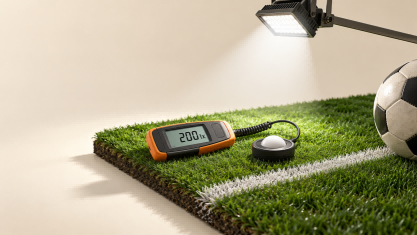
Lux measures illuminance: the light arriving on a surface. For a football pitch, the usual starting point is horizontal illuminance on the playing plane. A calculation grid covers the field and reports average, minimum and sometimes maximum values. This shows whether the grass, markings and ground-level ball movement are adequately lit.
Horizontal and vertical illuminance serve different purposes
Horizontal illuminance is most relevant to the pitch surface. Vertical illuminance describes light on vertical surfaces or in a viewing direction, such as a player’s face or a raised ball seen by a camera. A training pitch may be designed mainly around horizontal values. A venue with video or broadcast use needs a more detailed review because players and the ball must be visible from the relevant camera directions, not only from above.
Why Average Lux Is Not Enough
Two fields can both average 200 lux and play very differently. One may have a bright centre and weak goalmouths; another may hold its lowest values much closer to the average. The second design is usually easier for players because their eyes do not need to adapt as they move from the centre toward the corners and penalty areas.
Uniformity is often written as U0 = Emin / Eavg. If a field averages 300 lux and the lowest measured point is 210 lux, U0 is 0.70. The calculation does not replace practical commissioning, but it is a useful way to compare alternatives. Raising the lowest areas can provide more playing value than increasing already-bright zones.
Check the distribution, not only the summary
Ask to see the full calculation grid or false-colour map. Look closely at the goal areas, touchlines, corners and the zones farthest from each mast. A high average can conceal poor edges. The report should identify the calculation plane, point spacing, maintenance factor and the photometric file used so the stated lux result can be interpreted correctly.
How Field Size and Layout Change the Answer
A compact training field and a full-size stadium pitch may host the same sport, but they do not place luminaires at the same distance from the target. Pole count, mast height, setback and aiming angles determine how efficiently light reaches the far side of the field. Low masts tend to require steeper aiming angles, which can increase glare, unevenness and spill light. More masts can give a designer more directions from which to fill dark areas, but they also add civil and electrical cost.
For this reason, “how many lux” should never be answered with a wattage shortcut. The fixture output, beam distribution and real mounting geometry are part of the answer. A lower-power luminaire with an appropriate narrow distribution may provide more useful light at the far side than a more powerful unit with a poorly matched optic.
Set the Lux Target Before Selecting Fixtures
New construction
For a new field, define the intended use and target performance before mast foundations are built. Provide the pitch dimensions, runoff area, mast coordinates, expected mounting height, nearby roads or homes, supply constraints and any screen or stand locations. A designer can then test alternative mast arrangements and determine whether the target uniformity is realistic before the expensive geometry is fixed.
Retrofit projects
For a retrofit, survey the existing geometry rather than assuming an LED fixture can replace a metal-halide fitting one for one. Record the mast heights, crossarm positions, tilt limits, circuit capacity and current aiming directions. New LEDs often have different beam shapes and source luminance. A new calculation can preserve useful infrastructure while identifying where brackets, optics or mast changes are needed.
Account for Glare and Spill Light Alongside Lux
A field can exceed its lux target and still be uncomfortable if bright luminaires sit in common viewing directions. Goalkeepers and players tracking high balls are especially sensitive to fixtures behind the goals or at steep angles. Glare review should start with mast locations and aiming, not after installation. The calculation should also examine boundary spill and upward light when homes, roads or public spaces are nearby.
The practical approach is to send light where it is needed with the least visible source brightness from player and neighbour viewpoints. Controlled distributions, suitable mounting height, careful rotation and documented aiming points are usually more effective than simply reducing power after a complaint.
What to Request in a Football Lighting Proposal
- Target average and minimum horizontal illuminance, with the stated measurement grid.
- Uniformity result and a point-by-point table or false-colour distribution map.
- Mast positions, mounting heights, fixture count, wattage, optic and aiming coordinates.
- Photometric files and the maintenance factor used for the calculation.
- A statement of assumptions for glare, spill light, competition class and any camera use.
This information lets a buyer compare proposals on field performance instead of wattage alone. It also gives the installation team a record of what was modelled and makes future maintenance more controlled.
Frequently Asked Questions
How many lux does a recreational football field need?
About 75 lux is a common reference point for training, schools and recreation, often with an Emin/Eavg uniformity near 0.50. Confirm local requirements before treating it as a final specification.
How many lux does a club football field need?
Around 200 lux with stronger uniformity is a common reference for regional and club competition. The appropriate target depends on the league, spectator conditions and field geometry.
Is 500 lux enough for a professional football field?
About 500 lux is a commonly cited reference for high-level play, but professional or televised venues may need additional vertical illuminance, glare and camera-direction criteria.
What is more important, lux or uniformity?
Both matter. Lux establishes the general light level; uniformity indicates whether low areas will disrupt play. A field with the same average but better minimum values will usually feel more consistent.
Can I calculate football lighting from watts per square metre?
Only as a very rough budget estimate. Final design needs the actual fixture photometry, mast geometry, aiming and maintenance assumptions.
Why do goal areas look dark even when the average lux is high?
The centre of the field can raise the average while the far corners and goalmouths receive less light. Review the full calculation grid and adjust beam distributions or aiming points to improve the lowest values.
Conclusion
The right football field lux level follows the field’s intended use and governing requirements. A simple training field may begin around 75 lux, a club venue around 200 lux and a high-level venue around 500 lux, but the number becomes useful only when uniformity, glare, field geometry and any vertical-lighting need are addressed. Use a site-specific lighting simulation to turn the target into a reliable fixture, mast and aiming plan.