Padel Court Lighting: A Complete Guide to Design, Lux, Glare & Costs
- VKS
- Sep 11, 2026
- Blog
How Much Light Does a Padel Court Need?
The required lighting level depends on how the court will be used.
For many padel projects, 200, 300 and 500 lux are useful reference levels for recreational, club and competition applications. The exact requirement should follow the project specification and the applicable local or sports lighting standard. But the average lux value is only part of the picture.
A court with 500 lux average illumination may still have poor lighting if some areas are much darker than others. This is why uniformity is also important. A common measure is U0, calculated as the minimum illuminance divided by the average illuminance.
For example, a court with 500 lux average and 350 lux minimum has a uniformity of 0.70. For players, better uniformity means fewer sudden changes between bright and dark areas. This makes it easier to follow the ball as it moves across the court. So when comparing two padel lighting proposals, do not look only at the average lux. Check the average lux, minimum lux and uniformity together.
What Makes a Good Padel Court Lighting Design?
A good padel lighting design starts with the court and installation conditions, rather than with a particular lamp wattage.
The first things to confirm are the court layout, indoor or outdoor use, mounting height and required lighting level. These determine where the lights should be installed and what optical distribution will work best.
The fixture position is especially important because players regularly look toward the upper part of the court. A light source that looks acceptable from the ground can become uncomfortable when a player looks up during a high lob or smash.
The beam angle also needs to match the mounting height and position. A narrow beam can create bright spots, while a very wide beam may send too much light outside the playing area.
This is why there is no universal answer to questions such as “How many lights does one padel court need?” or “Is 400W enough?”
The same 400W light can produce very different results depending on its optics, mounting height and position.
A professional design should therefore work backwards from the required lighting result:
Target lux → uniformity → mounting height → optics → fixture position → fixture quantity → simulation
That approach is more reliable than choosing a number of lights first and checking the result later.
Why Is Glare So Important in Padel Lighting?
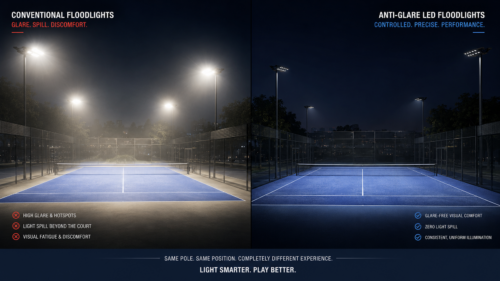
Glare is one of the biggest challenges in padel lighting because players often look upward while tracking the ball. A lighting system can provide enough lux and still feel uncomfortable if players can see bright LED sources directly.
This is particularly important in indoor clubs, where ceiling height can be limited and there may be little space to move the lights away from player sightlines. Outdoor courts have their own challenges because pole position, aiming angle and the darker surroundings can make bright light sources more noticeable.
Good glare control usually comes from a combination of fixture position, optics, shielding and the way light is distributed across the court. For a more detailed explanation of why glare can matter more than simply increasing brightness, see:
Why Glare Matters More Than Brightness in Modern Padel Clubs
Floodlights or Linear Lights for Padel Courts?
Both LED floodlights and linear lights can be suitable for padel courts. The better option depends on the project.
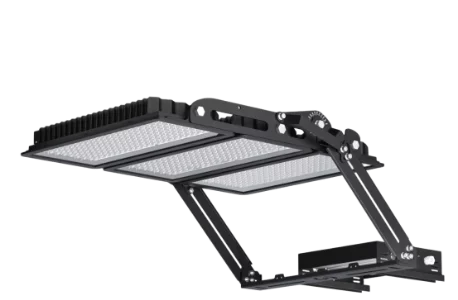
Floodlights are commonly used outdoors because they can deliver high light output from a relatively compact unit. With the right optics and pole arrangement, they can provide good coverage for a court.
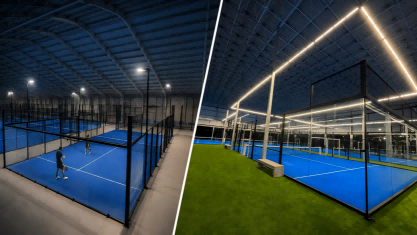
Linear lighting takes a different approach. Instead of concentrating the light source in one small area, it distributes light along a longer fixture. This can be useful for indoor courts, especially where a perimeter or continuous lighting arrangement is preferred.
The choice should not be based only on appearance or fixture price. The important question is which system can achieve the required lux and uniformity while keeping glare under control. We have compared these two approaches in more detail here:
Traditional Floodlights vs Modern Linear Lighting for Padel Courts: Which System Fits Your Project?
Indoor vs Outdoor Padel Court Lighting
Indoor and outdoor courts should not be treated as the same lighting project.
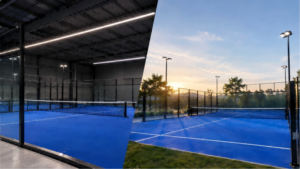
For indoor padel court lighting, ceiling height and roof structure are often the first limitations. The available mounting points may also determine where the lights can go. Because there is no daylight contribution at night, the artificial lighting system needs to provide the complete lighting level. Low-glare optics are particularly useful for indoor clubs. A distributed lighting system can also help avoid having a few very bright sources in the player’s direct view.
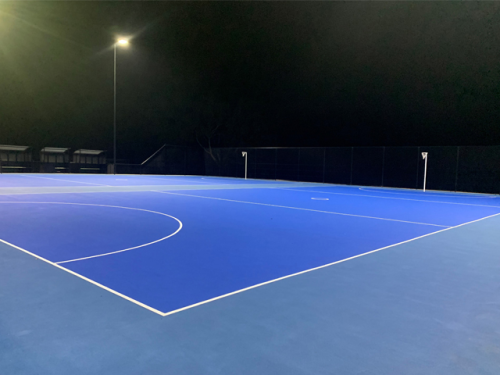
For outdoor padel court lighting, pole height and pole position become more important. The design also needs to consider weather exposure, wind, surrounding properties and light spill outside the court. Outdoor courts are often darker around the playing area, so glare from a high-output light can become more noticeable. The aiming angle and optical distribution should be checked carefully rather than adjusted only after installation.
In both cases, the best layout is the one that gives the required lighting performance without creating unnecessary brightness or spill.
Why Is Lighting Simulation Important?
A padel lighting simulation is one of the easiest ways to check whether a proposed design will actually work before the lights are installed.
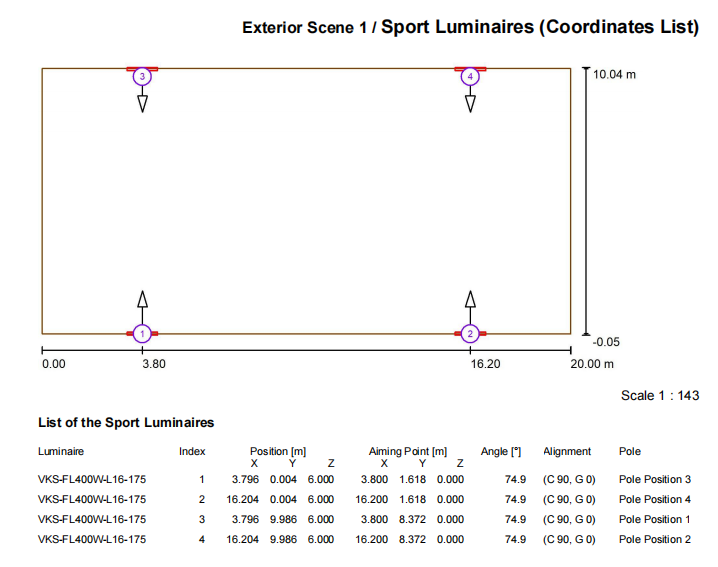
A DIALux or similar calculation can show the average illuminance, minimum illuminance, uniformity and glare result. It can also help compare different fixture quantities, mounting heights and beam angles. This matters because a product datasheet cannot tell you how a group of lights will perform on a specific court. For example, changing the mounting height or moving the lights by a small distance can affect both uniformity and glare. A different optic may also allow the same fixture to cover the court more effectively.
For a commercial project, the simulation should be based on the actual court dimensions and proposed installation positions rather than a generic layout.
A Real Padel Court Lighting Example
Real project data is useful because it shows what a lighting system can achieve in an actual design.
In one outdoor project, four padel courts were each designed with four 400W linear high-bay lights at a mounting height of around 6 metres. The simulation achieved more than 500 lux average illuminance, with U0 = 0.80 and a maximum glare value of 27. The result shows that a linear system does not have to be limited to indoor applications. With the right mounting position and optical distribution, it can also be used for outdoor padel courts.
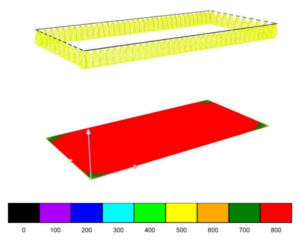
Another indoor project used a continuous ring lighting arrangement with 42 lights. The total installed power was around 2,905W, with a simulated average of 822 lux, U0 = 0.85 and glare below 16.
These projects also show why fixture quantity and wattage should always be considered together with the final lighting result.
What Are the Most Common Padel Lighting Mistakes?
Most lighting problems are not simply caused by having too little light.
One common mistake is choosing lights only by wattage. Another is looking at average lux without checking uniformity. Glare is also often considered too late, after the fixture positions have already been decided. Using the wrong beam angle can create bright spots or leave parts of the court underlit. Installing powerful lights too close to players can also create unnecessary glare.
The good news is that most of these problems can be avoided before installation with proper layout planning and lighting simulation. We cover the four most common design errors in more detail here:
Padel Lighting Mistakes: 4 Design Errors Players Notice Immediately
How Should You Choose Padel Court Lighting?
When choosing LED lights for padel courts, start with the project requirements instead of comparing wattage or unit price alone.
Ask the supplier to show how the proposed lighting system performs on your actual court. A useful proposal should include the fixture specification, optical distribution, mounting height, fixture quantity and lighting simulation. It is also worth checking the expected glare level, warranty, thermal design and protection rating, especially for outdoor courts. For club owners and contractors, this makes it easier to compare different suppliers on the same basis.
A cheaper light is not necessarily a cheaper solution if it requires more units, creates poor uniformity or needs additional changes during installation.
The best system is the one that achieves the required lighting performance with a practical fixture quantity, reasonable energy use and good long-term reliability.
FAQ
How many lux does a padel court need?
It depends on the use of the court. Around 200 lux may be suitable for some recreational applications, while 300–500 lux is more common for club and competition-level projects. The final target should follow the project specification and applicable standard.
Is 500 lux enough for a padel court?
500 lux can be suitable for many club and competition applications, but average lux alone does not determine lighting quality. Uniformity and glare should also be checked.
How many lights are needed for one padel court?
There is no fixed number. The required quantity depends on fixture output, optics, mounting height, position and the target lighting level. A lighting simulation is the best way to determine the right quantity.
Are linear lights good for padel courts?
Yes. Linear lights can provide a more distributed light source and can work particularly well for indoor or perimeter lighting. They can also be used outdoors when the fixture, optics and layout are properly designed.
Do I need a lighting simulation?
For a professional padel project, a simulation is strongly recommended. It can show whether the proposed design achieves the required lux, uniformity and glare performance before installation.