FIFA Lighting Standards for Football Stadiums
- VKS
- Nov 27, 2026
- Blog
A football pitch can average 2,600 lux and still fall short of Standard A under the FIFA lighting standards. The average gives you an overall reading. It tells you little about how much the light drops near the goalmouth or how well a camera can see a player from the opposite side of the pitch. Before deciding where to put the floodlights, confirm which competition the venue will host and what its broadcast coverage will require.
Which FIFA Lighting Standards Apply to Your Pitch?
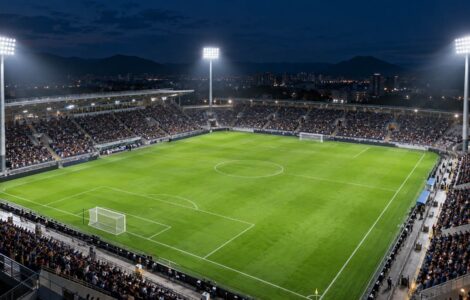
FIFA’s Stadium Guidelines describe Standards A to D for televised venues and Standard E for venues without television coverage. For a FIFA event, check the competition documents and host agreement for the required level. For domestic league play, start with the league’s own requirements. If live coverage is a realistic next step, discuss it before fixing the mast or roof mounting positions. Once those positions are set, it can be difficult to light the pitch from another direction. FIFA Stadium Guidelines, section 5.6.2
The table shows selected targets for FIFA lighting standards in the FIFA Lighting Guide 2020. Read the vertical average for each of the four reference directions separately. A strong result in one direction cannot make up for a weak result in another. Use the full guide and the event brief for the remaining design and test criteria.
| Stadium standard | Horizontal illuminance (Eh) | Average vertical illuminance (Ev) per direction | Horizontal uniformity (U2h) |
|---|---|---|---|
| A | Average above 2,500 lux | Above 1,500 lux | Above 0.70 |
| B | Average above 2,000 lux | Above 1,000 lux | Above 0.70 |
| C | Average above 1,250 lux | Above 700 lux | Above 0.60 |
| D | Above 1,000 lux* | Above 400 lux | Above 0.60 |
The Standard D table gives a horizontal threshold above 1,000 lux without specifying whether it is the average or the minimum. Confirm the assessment basis in the project brief. FIFA Lighting Guide 2020, sections 1.6 to 1.9
Training pitches have a separate grading system. The guide puts the average horizontal requirement above 300 lux for Grade 3 standard training. It rises to above 500 lux for Grade 2 match practice and above 750 lux for Grade 1 FIFA World Cup training. Each grade has additional criteria, so give the training ground its own specification when it shares a site with a stadium. FIFA Lighting Guide 2020, training pitch requirements
Why a Pitch Can Average 2,600 Lux and Still Fall Short
Horizontal illuminance measures the light reaching a plane parallel to the pitch. Vertical illuminance measures it on an upright plane facing a particular direction. Picture a player turning to receive the ball. The turf can look evenly lit while a camera on the far side picks up the player’s face in shadow. Calculating vertical illuminance in each reference direction lets the design team see where this can happen.
Now take a pitch with a horizontal average of 2,600 lux. The darkest point measures 1,600 lux and the brightest measures 3,400 lux. The average and minimum both clear the Standard A thresholds. The two uniformity ratios tell a different story. Divide the minimum by the average and you get a U2h of about 0.62, short of the requirement to exceed 0.70. Divide the minimum by the maximum and you get a U1h of about 0.47. That value needs to exceed 0.50. In this case, the design team should look at the low points first and see whether a change in aiming can bring more light to them. FIFA Lighting Guide 2020, illuminance uniformity
What FIFA Lighting Standards Check Beyond Lux
A goalkeeper tracking a high ball can lose sight of it when a bright floodlight sits in the same line of sight. The guide specifies a glare rating below 50 for Standards A to D. Check how each beam looks from the pitch at its proposed mounting height and aiming angle. Those choices also affect how much light reaches neighbouring homes or roads, so review spill light at the site boundary where relevant.
For broadcast, the FIFA lighting standards also address flicker. Light that looks steady from the stands can show visible changes in brightness in slow motion footage. The Standard A table sets both the average and maximum flicker factor below 1%. Colour rendering affects how faithfully kit and skin tones appear. Colour temperature affects how warm or cool the image looks. At tender stage, request data for the specified luminaire and driver combination. Agree which operating modes need to be checked.
The electrical brief also needs to cover match continuity. Standard A calls for lighting to continue without interruption. If that requirement applies, involve the electrical team early so the power and control strategy can be reviewed alongside the floodlight layout. FIFA Lighting Guide 2020, stadium standards and match continuity
What VKS Can Do Before You Order Floodlights
If you are upgrading an existing stadium, start by checking whether the current masts can deliver the required uniformity and vertical light. VKS can build a DIALux model using the IES photometric files for the proposed LED floodlights. We use the model to compare beam options and aiming points against the project brief. When the project calls for vertical illuminance, we can include the specified calculation planes and see which directions need more light. That gives you a basis for deciding whether a change to the mounting positions is worth exploring.
The contractor can use the fixture schedule to check the delivery against the design. For each position, the schedule identifies the specified model and optic. It also records the input wattage and aiming direction, so the crew can match the fixtures on site to the ones used in the calculation. Football Field Lighting Guide and Sports Lighting Contractor Guide
Compare connected loads once two layouts meet the same targets in the model. Suppose one draws 20 kW and the other draws 24 kW. If both run at full load for 1,800 hours a year, the 4 kW difference saves 7,200 kWh. At $0.15 per kWh, that comes to $1,080 a year. Use your own operating hours and electricity rate to see what the difference is worth at your stadium.
How the Installed System Is Verified
The FIFA Lighting Guide 2020 sets out a standard stadium procedure with 96 grid locations. The tester takes one horizontal reading and four vertical readings at each location, all 1 m above the playing surface. That makes 480 readings in total. Set up the same grid and directions in the design model so the commissioning team can compare its readings with the predicted values. FIFA pitch illuminance data and test procedure
The FIFA Quality Programme for Floodlights sets the certification process for the installed system. If the project requires a FIFA Quality mark, confirm the supplier’s licensee status before ordering and involve a test institute accredited by FIFA. The process starts with a product audit and a review of the modelled design. The institute then tests the system on site. VKS can supply design and fixture documentation for the review. Certification depends on the programme’s eligibility and testing requirements. FIFA Quality Programme for Floodlights and FIFA floodlight testing process
Frequently Asked Questions
Does every football stadium need 2,500 lux?
The 2020 guide calls for an average horizontal illuminance above 2,500 lux under Standard A. Other standards set different thresholds. Ask the competition organiser which level applies to your venue.
Can we keep four existing corner masts?
It depends on the mounting positions and the required performance. FIFA’s 2020 guide says four corner masts will generally fall short of Standard A. For a retrofit, model the current masts first. You can then see which targets the existing arrangement can meet and whether the pitch needs light from another position. FIFA Lighting Guide 2020, stadium design guidance
What should I send VKS for a first review?
Send a scaled site plan with mounting coordinates and heights. Include any known camera positions. If your brief refers to FIFA lighting standards, send the required class and the event criteria as well. For a retrofit, add photos, bracket details and any electrical constraints. An existing fixture schedule is helpful if you have one.